AI-generated satirical illustration commissioned by the author: aircraft with Microsoft logos and an error screen. Not a documentary photograph.
On October 28, 2026, at 8:31 in the morning, the #LZB train protection system on the #highspeedrail line between #Madrid and #Seville loses transmission. Operations switch to the backup system, and twenty-two minutes later, just outside the station of #Urda, an #AVE train rear-ends a stopped #Iryo train. That line was a living construction site: since 2021, #Adif has been installing #ERTMS along the entire route while keeping the old LZB running through an #interface, without stopping service. ERTMS was not in commercial operation that day, and nobody has proven that the #migration caused the failure. But the context is exactly that: an #infrastructure being rebuilt under traffic, while the trains keep running.
Sixteen days later, in the #UnitedStates, the same challenge. The #FAA is converting #airtrafficcontrol telecommunications from copper to #fiber, inserting new equipment into a network that must keep #aviation moving. On November 13, during that work according to the Transportation Secretary, a #router that had just been worked on destabilizes the network of control centers, and the country freezes departures nationwide. Two different worlds, one identical problem of method: the new goes into production on top of the old, with the service live. And under that condition, certifying the final system is not enough: the interfaces between what arrives and what stays, and every state of #transition, are concrete intermediate configurations to be proven, and each one demands its own validation.
And here is the thesis. Technical failure is possible, it must be expected, and precisely for that reason it is a design assumption: a serious system accepts it from the start and builds containment, backup, and restart around it. Accepting failure does not mean accepting unlimited damage. The competence we must demand from whoever signs these programs is not knowing how to configure a router: it is knowing how to demand evidence, read real indicators, and keep the #accountability that no contract can transfer. Failing to do so is governance incompetence, even when every invoice is formally in order.
Microsoft and the FAA: Two Failures, No Proven Link
On November 12, at 18:26 UTC, the incident that #Microsoft tracks as MO1550821 begins: users all over the world locked out of #Outlook, #Teams, #SharePoint, and #Copilot. The declared dynamic is a textbook #cascading failure: #servers fail their automated health checks and drop out of service, load pours onto the remaining ones, which buckle in turn. The company itself clarified that the high load was not a traffic surge but vanished #capacity: not more people knocking at the door, fewer doors. And not all of Microsoft went dark, nor all of Azure: the casualties were the services that depend on #ExchangeOnline and mail, with Teams hit mostly in calendar and invitations. Recovery was a battle against the company's own #automation, until the announcement on November 14, around 06:00 UTC, that service was restored for all regions: an overall window of roughly thirty-five and a half hours, with a progressive, uneven recovery across regions, not a day and a half of darkness for every customer. As for the initial trigger, there is still no conclusive reconstruction.
On November 13, at 20:54 UTC, the American air traffic command published advisory 111: a nationwide ground stop, all #airports, for #safety reasons. Aircraft already in the air remained under control, many diverted; departures stayed frozen for more than four hours. The next day, Secretary Sean Duffy and Administrator Bryan Bedford gave the detailed version: during #maintenance tied to the fiber conversion, a router began flooding the other devices with more than a thousand connection attempts roughly every five seconds, degrading the #data and #radar feeds. No center went completely dark, Bedford specified. And for about forty-five minutes, they admitted, nobody knew what was destabilizing the network. Duffy narrowed the hypotheses down to incompetence or faulty equipment; the investigation remains open and there is no public evidence of an attack.
Between the two American failures there is no proven connection, and temporal proximity does not manufacture a conspiracy. But precisely because no saboteur is needed, the news is worse: the infrastructures we have built, outsourced, and neglected are enough on their own. In both cases the damage spread through the system, and brochure #availability proved insufficient by itself: it says how often the system works, not how much it hurts when it stops, nor how long it takes to get back up under real load.
A separate chapter belongs to #SMART, the #ArtificialIntelligence planning platform the FAA extended to all 22 en-route centers on November 10, three days before the shutdown. SMART aggregates about 200 data feeds and produces recommendations validated by human specialists: it is not a national autopilot, and Bedford bluntly denied any evidence of a role in the failure. But rejecting a cause without proof does not excuse anyone from evaluating the method. SMART is exactly the new on top of the old, and it is legitimate to ask what integration, load, and anomalous-behavior testing every intermediate configuration of the #rollout has passed. These are the same questions the Spanish rail program carries. The intermediate configuration requires its own safety case: the final design does not certify it retroactively. That is the parallel, not proof of a cause.
Maileva: The Fourth Case, and This Time It Is an Attack
Meanwhile, in #France, a different kind of story was unfolding. #Maileva, a French platform of #Docaposte, a subsidiary of the #LaPoste group, which prints and mails correspondence for companies and public administrations, suffered a confirmed #cyberattack in mid-September, with data theft. On November 14, La Poste released the management's statement: 22 million people affected by the theft of first name, last name, and postal address; according to the company, no banking data. And pay attention to the scope of the breach: those 22 million are not Maileva's customers. They are the recipients of letters mailed by thousands of client companies. People who may never have known Maileva existed, their data concentrated at an invisible vendor deep in the #supplychain. The figure covers identification data, not contents; there are, however, notifications from individual clients, including the #Foch hospital, about the possible exposure of the contents of some letters: payment reminders carrying invoice numbers, dates of care, and amounts. Maileva has notified the #CNIL, filed a criminal complaint, and a judicial investigation is underway.
So why did eight weeks pass between the intrusion and the overall public confirmation? The question deserves precision, not a legalistic sermon. It is not true that Maileva stayed silent until November: on September 23 it preventively shut down all services; by September 24 a communication to clients was already documented; by September 29 services were restored. On October 9 the first documented public #notification from a client appeared; in early November more followed. The Foch hospital states it learned on October 28 that the contents of some payment reminders sent between September 9 and 23 may have been accessed. The overall confirmation of the 22 million arrived in mid-November, not as a first-ever disclosure.
The European rules are precise. The #GDPR requires the data controller to notify the supervisory authority without undue delay and, where feasible, within 72 hours of becoming aware of the breach, unless the breach is unlikely to pose a risk to people's rights; the information may be provided in phases, without waiting for the forensic analysis to end. The processor must alert the controller without undue delay; and affected individuals must be informed without undue delay when the risk to their rights is high, with narrow exceptions, for instance when #encryption makes the data unreadable or later measures defuse that high risk. There is no automatic obligation to write to everyone within 72 hours. What we do not know, because nobody has published it, is when Maileva became aware of the theft, the dates of each controller's notifications, and how many of those 22 million have actually received individual notice. The September-to-November interval, by itself, proves neither an unlawful delay nor a cover-up. But the fact that the exact justification for those weeks has not been publicly clarified is, in itself, a #governance problem. And there is a contrast the timeline delivers on its own: the service restarts on September 29, while the reconstruction of the breach's full scope stays open for weeks, Foch learns on October 28, and there is no public record that the individual #protection of every affected person was ever completed. A reopened service does not certify that people are safe. An alert chain must also be measured by how long it takes to reach the person exposed to #fraud, not just by the number of notifications exchanged between companies.
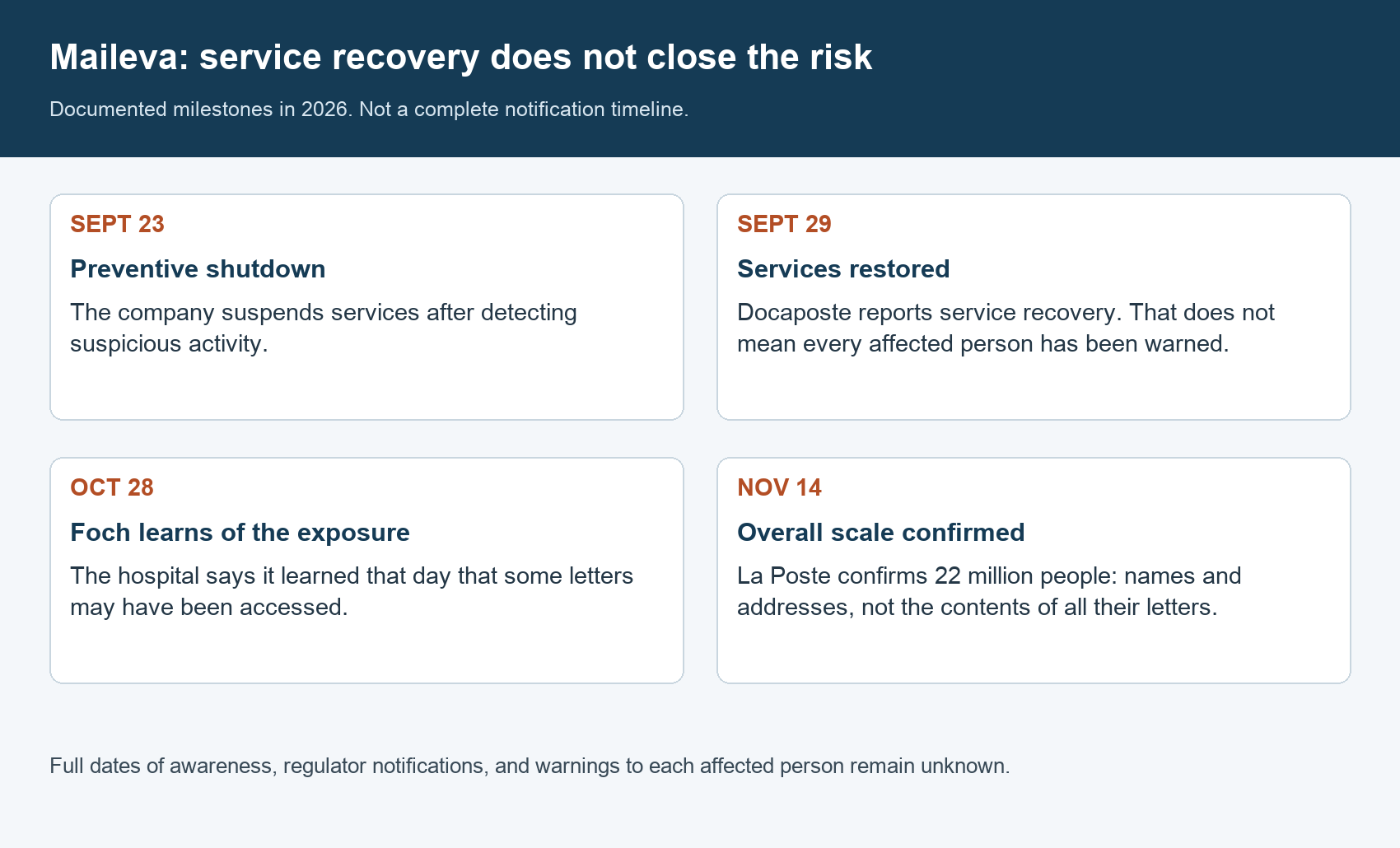
Maileva timeline: service recovery and knowledge of the scope are distinct milestones. Visualization by Raffaele Di Marzio from documented communications; the interval alone does not establish an unlawful delay. Hôpital Foch; Cronologia Maileva; La Poste/Maileva
Governing, Not Signing: KPIs, KRIs, Spares, and Centers That Keep Watch
The four cases converge here. Whoever governs these infrastructures must be able to answer three questions: how much can the system take, how does it contain a failure, and who decides when things go wrong. Serious #KPI work, the performance indicators, measures what has been observed, not what has been promised: detection, containment, and safe-restoration times; #failover tests, switching to the backup, and #rollback tests, undoing a change, passed under representative load with the primary unavailable; verification that each critical function recovers within its recovery time objective, the #RTO, and that data loss stays within the recovery point objective, the #RPO, where relevant. Measuring availability is not useless, it is insufficient on its own; and on timings, what counts are #percentiles and peaks, not the average that tames everything.
The #KRI set, the #risk indicators, measures the precursors of exposure: critical components without #telemetry, common dependencies between primary and backup, capacity margins during maintenance windows, untested interfaces, ungoverned privileged accesses of #vendors. A router able to destabilize the air traffic network and a fleet of servers knocking each other down call for indicators that flag insufficient margins, anomalous propagation, and loss of isolation. The final event is not a KRI: the observable conditions that can precede it are. What the internal indicators of the FAA, Microsoft, or Maileva actually were, we do not know: these criteria are what should be demanded, not a measurement of their systems. An indicator without a perimeter, a denominator, and a time window is a slide-deck number; without an owner, a threshold, and a predefined action, it is an alibi.
The same rigor applies to spares. #Redundancy is not owning two boxes: it is a reserve of equipment, links, power, capacity, and skills that is genuinely usable and independent for the scenario at hand. Two devices with the same #firmware and the same logical identity stay exposed to the same common-mode error. September's precedent on the East Coast illustrates it without theory: error messages push the FAA onto the fiber backup line, and the next day a contractor accidentally cuts precisely that #backup cable. The Spanish investigating authority put exactly this in writing in its November recommendations: the transition to the backup system carries risks of its own and, until the protocols are reviewed, the resumption of service after a switch to the backup proceeds on sight. The state transition is one of the most delicate moments in the life of a system, and treating it as an operational detail is the best-proven way to turn an anomaly into a tragedy.
Third tool: competent centers that keep watch. Not the #SOC as a catalog line item, but competent people around the clock, with a security center that sees the attacks and a network center that sees the flows, integrated: logs, correlated telemetry, a clear chain of command, and real power to intervene. The goal is not instant attribution, which no serious center promises: it is responding at once and having the available evidence on the table immediately, not an infallible diagnosis. Forty-five minutes without knowing what is destabilizing the network, as happened to the FAA, is too long even when the problem has been spotted and departures frozen as a precaution: containing first was right, but weighing the #evidence has to start at that same moment. And I am not claiming the organizations named here lack these centers: the question is how fast those centers produced a useful picture. Forensic uncertainty must not become paralysis: you contain, you isolate, you degrade in a controlled way, while you investigate.
Who the Fuck Strengthens an Infrastructure by Weakening the People Who Understand It?
A failure that knocks out global #cloud services, an air traffic network that wobbles, 22 million names and addresses stolen: these are alarms that call for experience, method, and #resilience designed by people who know how the systems actually behave. The dumbest possible answer is to squeeze exactly those capabilities. When a buyer negotiates expert rates downward without weighing what it will lose, it can make leaving the rational choice for #senior people. If juniors labeled as seniors arrive in their place, without mentoring or equivalent #experience, the fault is not the juniors': it lies with whoever sells them as something they are not yet. A new rate card does not manufacture years of practice. The risk is losing operational memory: knowing which dependency never shows up in the diagram, which procedure fails under load, which alarm cannot wait until morning.
The pressure on #skills has data behind it. In the 2025 #ISC2 survey of 16,029 professionals, 29% report that their organization cannot afford to hire the skills it needs. The #ENISA report on 2025 #NIS investments, based on 1,080 European professionals, describes stable budgets tilted more toward technology and external services than toward internal teams. It does not document a general headcount cut; it documents an imbalance: purchased tools do not, by themselves, guarantee the ability to govern them. These figures do not prove that replacing seniors with juniors caused the incidents examined here. They make concrete the question that precedes any cut: which capability are we removing, and who absorbs the residual risk? If the answer is only a number saved, that is not #riskmanagement. It is shifting a cost from today's balance sheet to tomorrow's incident.
The Contracts: Where Risk Disappears From the Slides
And so we reach the point technical analyses usually dodge: the #contracts. The FAA's copper-to-fiber conversion is a multi-year program awarded to #L3Harris, which in its statement about the November 13 ground stop says it is working with the agency to clarify what happened and, along the way, reminds everyone it has completed more than 70% of the conversion. That is not an admission of guilt, and the investigation will assign responsibilities. But that 70% displayed as a credential in a statement about an incident is the exact symptom of the disease: 70% does not measure resilience. It measures the completion of planned activities, not the service's ability to withstand a failure, nor how many transitional configurations have been tested under fault conditions. A number like that shows the limit of using progress as a public answer to a safety question.
Here is the indictment: a contract measured only on delivery and progress can make it profitable to minimize risks in the slide decks until the engagement closes. It is the incentive mechanism that must be attacked, not an invented fraud by a specific vendor. Reported risk costs money: it delays milestones, opens arguments, shifts payments. Minimized risk never shows up in the immediate accounts; when it materializes, part of the bill lands on the passenger, the patient, the recipient of the letter. Breaking that mechanism takes clauses, not homilies: a competent buyer; verifiable evidence, not self-declarations; residual risk accepted by a named person with a signature, not by an evaporating committee; payments tied to passed resilience tests; and obligations that run through the entire chain of #outsourcing, because Maileva teaches that risk loves to live two or three links below the main contract. Execution can be outsourced; accountability cannot.
The U.S. Congress's watchdog documented, in September, specific gaps in the risk assessments and in the monitoring of #spectrum interference, jamming, and signal #spoofing in aeronautical communications: it is not an #audit of the router network and it does not explain the November failure, but it describes a public buyer that has not finished its own governance homework. Congress appropriated 12.5 billion dollars in 2025 to modernize air traffic control and the administration is asking for 30 billion more: an appropriation is not an outcome, and the legitimate question is one of government: with which priorities, verifications, and measurable results does that money become resilience rather than progress reports.
What Comes Next if Nothing Changes
The NEXUS reading of these signals is qualitative, no computed index, no date attached, and it is blunt: the risk does not end with the last recovery. The target of these lines is not the #junior, nor the technician who can err, nor the machine that can break. It is a way of governing systems that demands senior results after devaluing #expertise, buys resilience as a line item in a tender, and never checks whether it holds when needed. Transitions on live infrastructure, concentration on common vendors, difficulty retaining talent, failure propagation, and the timing of alerts are dimensions that must be watched together: if they stay untouched, expecting new crises is not pessimism, it is reading the evidence. Technical failure will remain possible. Accepting it as a design assumption means preparing containment, #continuity, spares, people, and restart criteria. Accepting instead that nobody knows who truly governs those capabilities means leaving the infrastructure in production and accountability farmed out to subcontractors. The next failure will not ask who signed the invoice. It will test whoever is still capable of acting.
Raffaele Di Marzio
All my “insane” books on cybersecurity and governance are here 👇 https://cyberium.limited/bookshelf.html
AI-generated satirical illustration commissioned by the author: aircraft with Microsoft logos and an error screen. Not a documentary photograph.