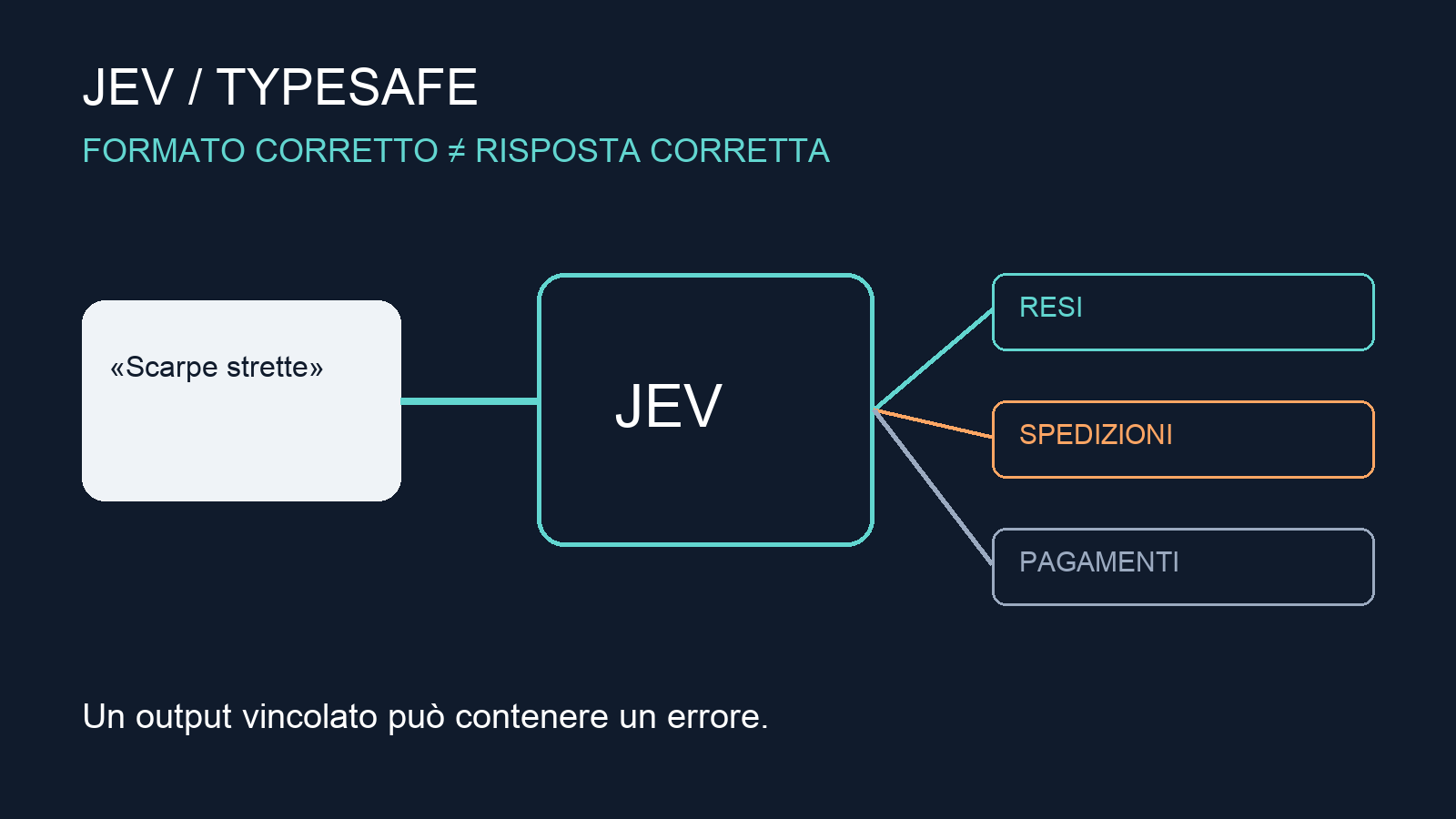
TypeSafe has introduced Jev, a model that takes a piece of text and a set of permitted answers, then returns estimates for those answers. A business can use it to sort a customer message into returns, shipping or payments. Jev does not console the customer, invent the categories or send replacement shoes. It classifies.
That description is useful because it allows us to identify the object underneath the ceremony. A new model family called System One, an intellectual nod to Daniel Kahneman, a name borrowed from William Stanley Jevons, and somewhere beneath the cultural upholstery a customer would like a larger shoe.
My image for the disproportion is a calculator powered by a quantum computer. It is an analogy about the sales performance surrounding the task, not a claim about Jev’s hardware. The customer asks for a practical result. The presentation arrives wearing the history of economic thought.
The answer has the right shape. Congratulations.
Developers define the categories and their descriptions. Jev can interpret meaning rather than merely search for a fixed keyword: “I need a bigger size” can point towards returns without containing the word “return”. It can also assign a score on a scale prepared by the business.
There is a specific engineering proposition here. Software expecting a constrained result does not need a chatbot to compose an essay. Restricting possible outputs avoids the problem of receiving free-form prose where a program expects a particular structure.
It does not make the selected answer correct.
This is the distinction I want kept in the foreground, rather than buried underneath the product’s ancestry. A wrong category can be perfectly valid. The software may accept it without complaint precisely because it conforms to the agreed format. The error arrives impeccably dressed and walks straight through reception.
Confidence does not repair that. A model strongly preferring one available answer is not proof that reality prefers it too. If the organisation has defined bad categories, omitted a necessary option or misunderstood the customer’s language, a neat set of numbers will not become wiser out of respect for the interface.
How stupid is the buyer supposed to be?
My objection is not that specialised classifiers must never be built. It is that buyers are invited to confuse the splendour of a product’s positioning with evidence that it deserves a place in their operations. I find that insulting. Show me how it behaves on the work I actually need done.
TypeSafe claims substantial speed and cost advantages in its own launch tests. Those are company comparisons under selected conditions, not a promise that every customer will obtain the same result. A fast answer to the wrong question is still wrong. A cheaper mistake may become more expensive once another system acts on it.
The relevant bill includes the consequences of classification, not just the price of processing text. A misrouted shoe enquiry may mean a delay. A score used in a financial, insurance or healthcare workflow can carry different stakes. Jev itself does not execute the next action, but another program can turn its output into one. The distinction assigns responsibility; it does not make consequences disappear.
Before the ceremony, there should be a plain account of error rates, difficult cases and what happens when the model cannot reliably distinguish the options. Instead, the buyer is left to separate a limited technical guarantee from the much larger feeling of certainty that polished numbers can produce.
Efficiency has an appetite
TypeSafe invokes Jevons’s paradox: make something cheaper to use and overall consumption may grow. That is also a revealing commercial ambition. Reduce the cost of automated judgements and businesses may insert them into more places.
More judgements do not automatically mean better decisions. If a weak classification is cheap enough to apply everywhere, its reach can increase faster than anyone’s willingness to inspect it. The customer receives the promise of precision; the person caught in a mistake receives a lesson in probability.
That is the part I refuse to applaud. Sell the classifier on demonstrated performance. Spare me the implied assumption that a distinguished name and enough decimal places will make me forget to ask what the thing gets wrong.
Raffaele Di Marzio
All my "insane" books on cybersecurity and governance are here 👇 https://www.amazon.it/stores/author/B0FB47T6Q4/allbooks