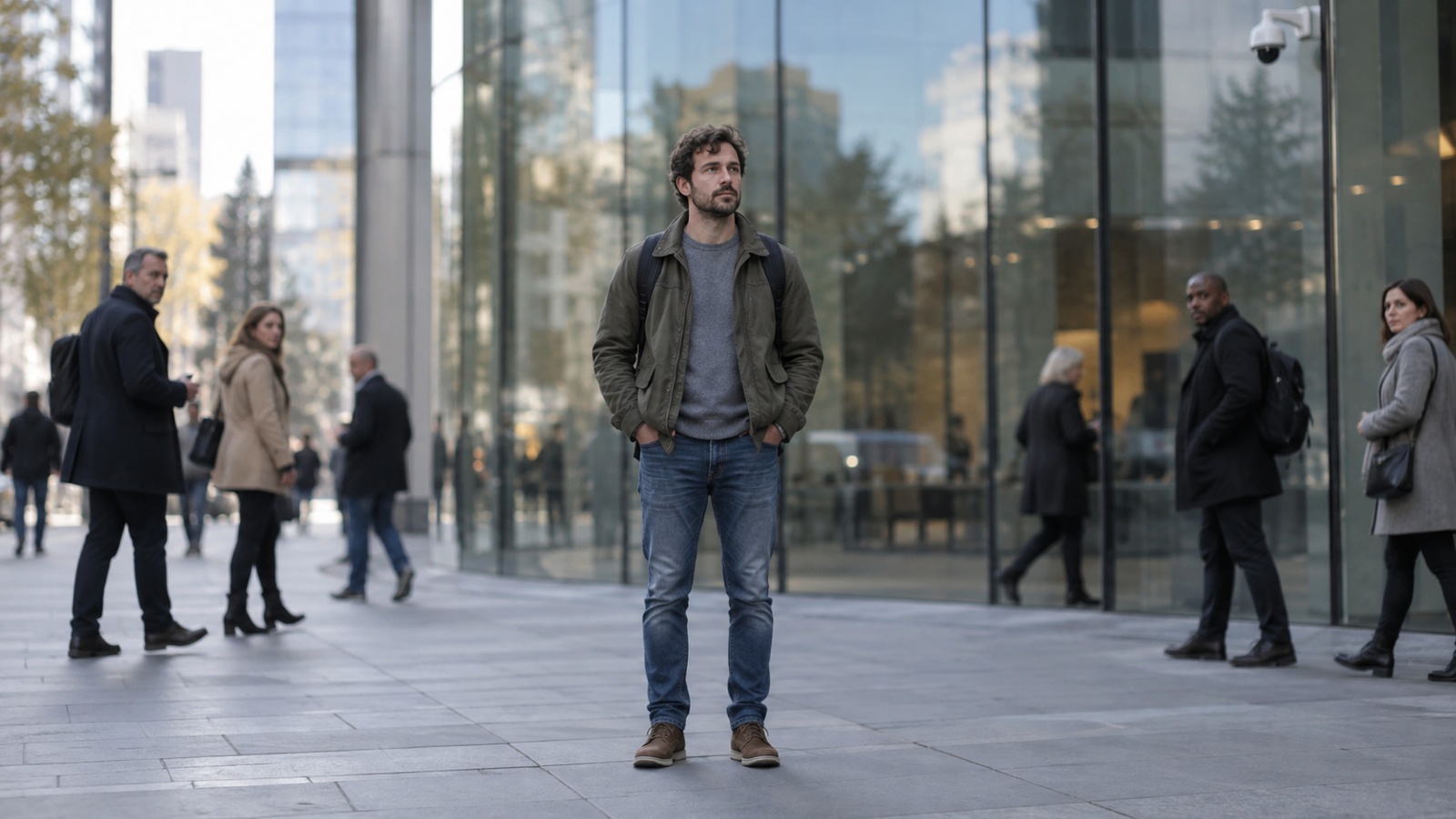
They told you that you were presumed innocent, and you naively stopped at innocent. Everyone else had already underlined presumed. A provisional word, a chair near the door: sit down, but don’t make yourself at home. Then came the conviction, at least the kind that needs no courtroom, and finally the most absurd grounds of all, the ones nobody will ever write down: for not having done it. Because you didn’t do it, but you failed to look enough like the innocent person they had in mind.
Three pieces of a sentence that ought to repel each other, and instead sit together on top of your life. Innocence granted with reservations, condemnation pronounced with confidence, the absence of guilt turned irrelevant. A contradiction? Of course. But contradictions are far less disturbing when somebody else has to live inside them.
Picture yourself there, telling the story of that same evening for the third time. Earlier you said «I left», now you say «I went away». Somebody looks up, and you understand that you will have to defend the distance between those two verbs as well. You go back, you clarify, you add a detail. You’re talking too much. You stop. Now you’re hiding something. You get angry and you’re aggressive; you lower your voice and you’re cold. There is no right answer, because the question has already decided who you are.
Judging another human being is difficult even when it barely concerns us. We see a gesture and ignore what came before it; we hear a sentence and pour our own history into it. We mistake confidence for sincerity, resemblance for reliability, discomfort for lying. And I too, as I write this, have to guard against the comfort of believing myself immune. The trouble starts when this short sight becomes convinced it is deep insight. When «it seems to me» puts on the robe.
I’m not saying we shouldn’t judge. I’m saying it should cost us something. That between an accusation and a conclusion there should be evidence, cross examination, a willingness to discover that we were wrong. Instead doubt weighs on us and the verdict sorts out our day. We’ve identified the bad guy, so we can go back to thinking of ourselves as decent people.
You, meanwhile, have to learn to resemble the expected stereotype of the innocent. Look people in the eye, but without challenging them. Remember everything, but without seeming prepared. Suffer, but with dignity, which usually means without inconveniencing the people making you suffer. They ask you for a perfectly controlled spontaneity, which is to say something that does not exist. And they have never met that innocent person: they inherited them from a convenient idea in which anyone without guilt is clear, orderly and reassuring. Every departure from that image gets read as a confession.
«If you did nothing wrong, why are you so worked up?». Because you’re destroying my life, for fuck’s sake. But that answer too risks ending up in the records of the informal tribunal: hostile subject, incapable of a calm discussion. Calm is demanded above all by the people who, when the discussion ends, can go out to dinner without carrying the accusation with them.
And so the work nobody sees can begin. You reread a message five times before sending it. You keep receipts you would have thrown away, you reconstruct timelines, you look for somebody who remembers running into you. Documenting can help; the torment arrives when you can no longer stop. A coffee becomes a potential alibi. A walk with no witnesses, a piece of recklessness. You start living by leaving traces, as though every day had to prepare the defence of the next one.
At night you find the perfect sentence. There it is, you tell yourself, tomorrow they’ll understand. You repeat it in the dark, you correct it, you remove a word that might sound wrong. In the morning you’re exhausted and that sentence saves nothing. Not because the truth has changed, but because the person listening to you is not always looking for a truth. Some people are defending their own judgement, and to do that they need you to remain the person they convicted.
You can end up ashamed without feeling guilty. Ashamed of walking into a room and watching a conversation drop in volume. Of having to explain to your children, your colleagues, someone you love, something you did not do. You feel dirtied by somebody else’s story, even though you know it isn’t yours. So you withdraw, you skip a dinner, you don’t answer the phone. «See? They don’t show their face any more». First they make it unbearable for you to be among other people, then they present your absence as a clue.
It doesn’t happen to everyone in the same way, and there is no behaviour that certifies innocence. Some shut down and some can’t stop talking, some look for help and some push away even a friendly hand. You can become impatient, unfair to the people who love you, unpleasant. But you don’t have to be a lovely human being at every moment in order not to have done something. Innocence is not a good conduct prize. You can have a foul temper and still be right. It’s a possibility that throws quite a few admirers of justice into crisis, especially when the foul temper isn’t theirs.
And if the accusation is finally disproved, it doesn’t follow that everything goes back where it was. The people who doubted you would like a clean ending, maybe a handshake. You might still have a phone full of evidence and a body used to the alarm. They’ve finished talking about it; you haven’t finished living it. «Now turn the page», they tell you. Their signature is on the previous one, and they’re in something of a hurry never to see it again.
It is from this difficulty of ours in judging that we have to start when somebody proposes handing more and more judgements over to machines. Not from the fairy tale of the fallible human being finally replaced by an authority without prejudice. An algorithm does not free itself of our criteria simply because it executes them without blushing. Somebody chooses the data, the categories, the objectives, the threshold beyond which a person becomes a risk. Somebody decides which errors are tolerable. And it would be interesting to know how much that tolerance would change if they were the one who had to suffer the errors.
I call virtual ethics those packages of values we risk handing to a system as if they were definitive: acceptable behaviour, correct language, normal reaction. But normal for whom? If the measure is whatever occurs most often, anyone falling outside the measure can become an anomaly before anybody has asked why. A majority, translated into an automatic criterion, does not thereby acquire a conscience. It acquires a capacity for enforcement.
And here is the persecuted person from earlier, in front of a new examiner. Talks too much, stays silent too long, contradicts themselves on a detail, uses angry words. If a system were trained to treat these signals as suspicious, it could repeat the old error with a speed and a reach that the gossip on the landing could only dream of. It would not be inevitable, it would be a choice of design and deployment. Which is exactly why I won’t accept it being sold as a technological destiny: somebody would make that choice, and somebody else would pay the bill.
The danger is not only a machine that gets it wrong. It’s the human being who stops answering for the error because «the system flagged it». Before, you had to convince somebody to change their mind; tomorrow you might have to find somebody authorised to do it. In the meantime your life stays suspended, but the procedure works.
From bad to worse? Yes, if we replace the effort of understanding with the convenience of classifying and call that surrender progress. If mainstream algorithms learn above all to recognise whatever resembles the norm, and we mistake that resemblance for justice. We promised you that a machine would never judge you by your face. Then we taught it to judge you by everything else, without ever looking at you.
Presumed innocent, convicted for not having done it. You will ask to be heard. They will tell you that you have already been processed.
Raffaele Di Marzio
All my “insane” books on cybersecurity and governance are here 👇 https://cyberium.limited/bookshelf.html