Notes on COP30 Belém, the Belém Package, and the Genre’s Signature Move
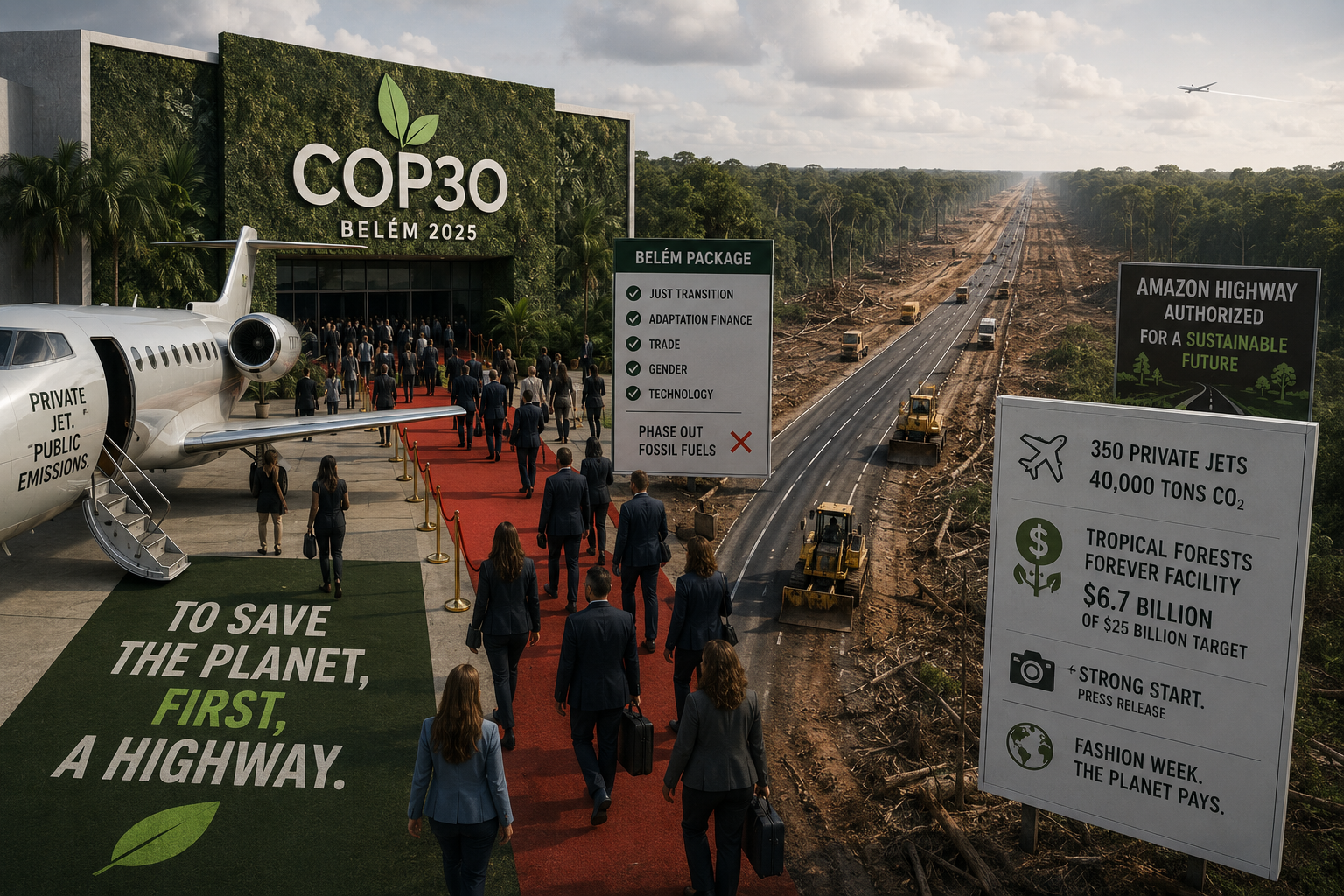
In November 2025, one hundred and ninety-five Parties met in Belém, Brazil, for the thirtieth Conference of the Parties to the United Nations Framework Convention on Climate Change. They arrived. Approximately three hundred and fifty of them arrived on private jets, generating an estimated forty thousand tons of CO₂ in transit. The organizers, in preparation for the conference, had authorized the construction of a four-lane highway through protected Amazon rainforest, so the delegates could reach the venue where they would, for two weeks, discuss saving the planet.
This article is a satirical note on what happened, what did not happen, and what the genre of the COP itself has become.
The Belém Package
The conference produced a final document called the Belém Package: twenty-nine decisions, adopted by consensus across the one hundred and ninety-five Parties, covering just transition, adaptation finance, trade, gender, technology, and the standard array of subsidiary topics that the COP cycle has accumulated over its thirty editions.
The package contained, prominently, an agreement to triple climate finance for developing nations. It contained, less prominently, no mention of a roadmap to phase out fossil fuels.
The omission was not accidental. More than eighty countries, including a majority of the European Union, Latin America (Colombia and Brazil), the African Group, the Pacific small island states, and several Asian economies, had advocated for a global roadmap to guide a just transition away from fossil fuels. Saudi Arabia, Russia, and a small block of petrostate allies threatened to collapse the entire negotiation if the words “phase out” appeared in the final text. The Brazilian Presidency, charged with delivering a consensus document, removed the words. The words did not appear.
Sources: UN News, Belém COP30 delivers climate finance boost and a pledge to plan fossil fuel transition; Health Policy Watch, COP30 Ends With No Text On Fossil Fuels Phase-Out; Carbon Brief, COP30: Key outcomes agreed at the UN climate talks in Belém; European Commission Climate Action, What did COP30 achieve?.
The Schedule-Another-Conference Move
Colombia’s President Gustavo Petro publicly rejected the declaration in a forceful gesture, calling out the omission of fossil fuels by name. The Brazilian Presidency, in response, announced that since COP30 had failed to address the question, a separate “First International Conference for the Phase-out of Fossil Fuels” would be held in Colombia in April 2026.
This is the contemporary climate-summit genre’s signature move. When the headline conference fails to produce a binding outcome on the topic that the previous year’s conference had identified as urgent, the answer is not to renegotiate. The answer is to schedule a separate, parallel, supplementary, and structurally non-binding conference, somewhere else, at a different date.
The First International Conference for the Phase-out of Fossil Fuels in Colombia, April 2026, will not produce a binding outcome either. It will produce a declaration. The declaration will be added to the next year’s negotiating text. The next year’s negotiating text will, in COP31 (held in a different city, with a different presidency, on a different continent), have the words “phase out” once again removed by the same petrostates, with the same threat to collapse the negotiations, and the cycle will repeat.
This is the genre’s version of perpetual motion. Document-producing, footprint-multiplying, outcome-deferring.
The Math
Brazil’s Tropical Forests Forever Facility, announced as a flagship Brazilian initiative for COP30, sought $25 billion in initial pledges from wealthy nations and private capital to fund a long-term endowment for tropical forest protection. The pledges received at COP30 totaled $6.7 billion.
The press release described this as “a strong start”. Twenty-seven percent of an initial fundraising target is, in the language of every fundraising professional I have ever met, not a strong start. It is, in the polite version, a partial start. In the less polite version, it is a signal that the fundraising assumption was wrong and the target will not be met without major changes to the offer.
The Tropical Forests Forever Facility will, in 2026, operate on roughly a quarter of the capital it was designed for. The protection ambition will be scaled accordingly. The forests, which do not negotiate, will continue to be cleared at the rate that economic pressure dictates, not at the rate that the pledge structure had hoped to slow.
The Private Jets and the Highway
The two physical artifacts of COP30 that the press has, in the months since November 2025, returned to most often are the private jets and the highway.
Approximately three hundred and fifty private aircraft transported delegates to Belém. Private aviation is, on a per-passenger basis, between seven and fourteen times more polluting than commercial flight. The aggregate emission of forty thousand tons of CO₂ from private aviation alone, in service of a conference whose object was emission reduction, is the kind of statistic that produces, in the climate-policy community, a small embarrassed silence. The silence is followed by the observation that the alternative (commercial flight for all delegates) is logistically complex. The observation is followed by the booking of next year’s private jets to Antalya, Turkey, where COP31 will be held in 2026.
The Amazon highway is the more permanent artifact. The conference’s organizers, including the host country’s federal government, authorized a four-lane road construction project through a protected rainforest area. The project’s stated justification was logistical access for delegates. The project’s permanent effect is fragmentation of an ecosystem, removal of a documented carbon sink, and a sealed corridor that will, over the coming decades, attract further development.
The highway, unlike the conference declarations, is binding. It is made of concrete.
The Fashion Week Analogy
The reading of COP as a fashion week of climate is, on first encounter, dismissive. On second reading, it is structural.
The schedule is annual. The destination changes every year, in a rotation that prioritizes geographic equity over operational continuity. The dress code is summit-business-casual, with cultural variations for the host country. The photographs are coordinated. The speeches are scripted to the second. The opening ceremony is choreographed. The closing communiqué is negotiated through the night, by exhausted delegations, and approved at dawn with adjectives whose precise meaning has been reduced over forty-eight hours of edits.
The commitments are not binding. The signatories are not penalized if they fail to deliver. The metrics are self-reported and selectively published. The audience, which is the global press for two weeks, returns its attention to other matters by the end of November.
The attendees, in the standard pattern, return home on the day after the closing, to the same emissions trajectories, the same lobbying relationships, the same fossil fuel subsidy structures, the same forest-clearing economic pressures, that they arrived with. The fashion week is, by November 23, over.
The next one will be in Antalya. The one after that will be in a city to be determined. The cycle continues.
What the Genre Has Become
This is not, importantly, a claim that the COP process produces nothing. The Belém Package contains real decisions: tripled climate finance for developing nations, the just transition framework, the adaptation finance arrangements. The Paris Agreement of 2015, an earlier product of the same genre, set a global temperature target that has, since its adoption, shaped national climate planning across most major economies.
The claim is narrower. The COP genre, in 2025-2026, has reached a point at which the gap between the urgency of the underlying problem (documented in every IPCC assessment) and the binding-ness of the outputs (reduced to consensus statements with strategic omissions) is structurally embarrassing. The fashion-week analogy is, on close inspection, the most accurate metaphor available for the gap.
The honest conversation, if there is to be one, would acknowledge that the COP process, as currently designed, is incapable of producing the binding fossil fuel phase-out that the underlying science requires. The honest conversation would propose a different mechanism. The mechanism would not require consensus among one hundred and ninety-five Parties, including the petrostates that veto the consensus by default.
This conversation is, at present, not being held. The next conference is, instead, being scheduled.
The COP30 declaration, the Belém Package, the Tropical Forests Forever Facility pledge gap, the rejection by Colombia, the announcement of the April 2026 Colombia conference, the private jets, and the highway through the Amazon: these are the seven artifacts of the November 2025 conference that the climate-policy historian of 2050 will, with some confidence, be able to assemble into a coherent picture of the moment.
The coherent picture will not be flattering.
In the meantime, the next round of badges is being printed for Antalya. The dress code for the Mediterranean edition is, by tradition, slightly more relaxed.
The Amazon highway, meanwhile, is still there. It is, at least, made of carbon.
All my “insane” books on cybersecurity and governance are here 👉 https://www.amazon.it/stores/author/B0FB47T6Q4/allbooks