European Digital Sovereignty, and the Pattern of Consolation Prizes
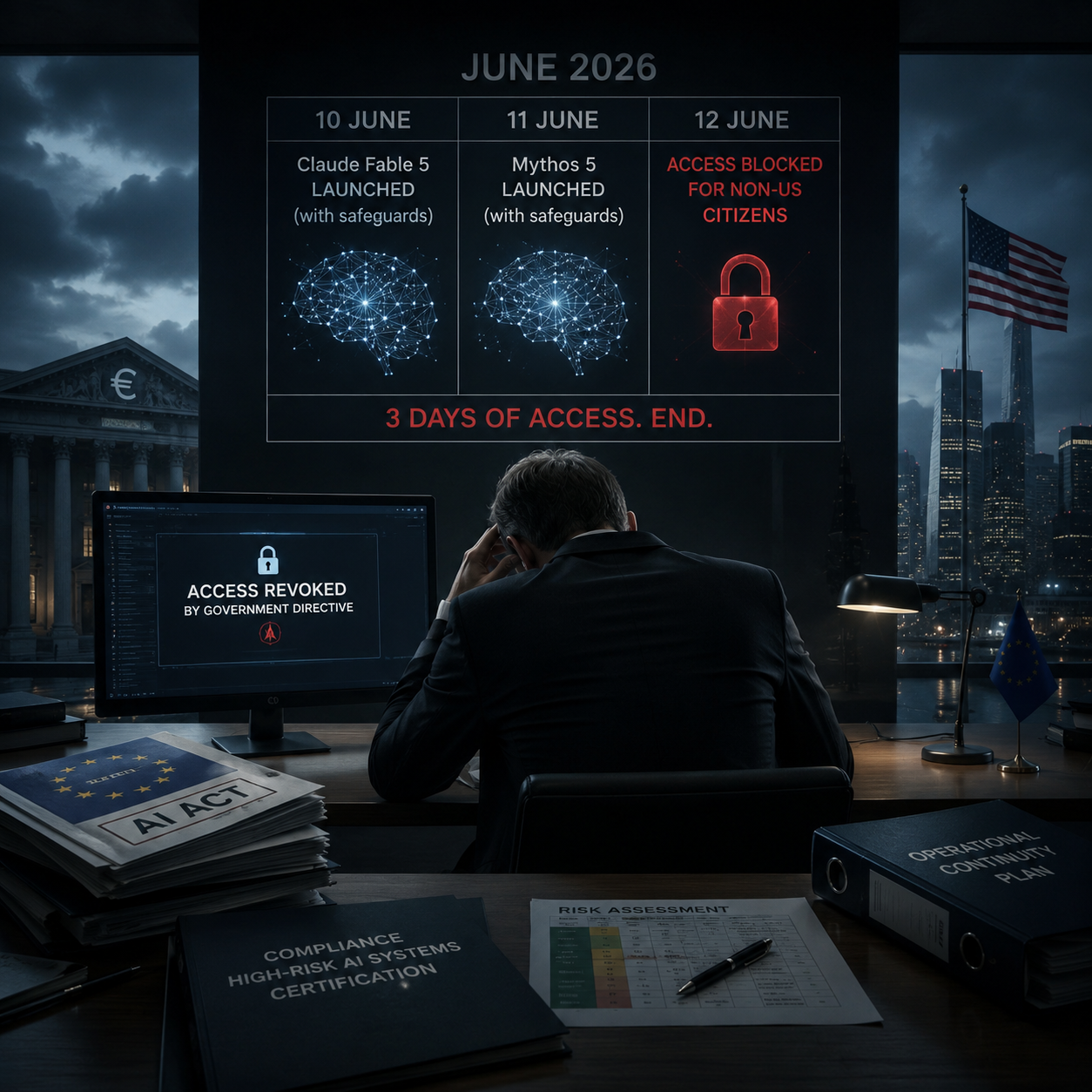
On June 9, 2026, Anthropic announced Claude Fable 5 and Claude Mythos 5, presented as the “with safeguards built-in” versions of its frontier models, capable of “Mythos-class” capabilities and made accessible outside the United States through AWS Bedrock. The product message was clear: after weeks of European political pressure on the exclusion from Project Glasswing, Anthropic was opening up. Not the full model, of course, but a mitigated version, properly safeguarded, responsibly released. The global community finally had access. On June 12, three days later, the United States government issued an export control directive citing national security. On the same day, Anthropic disabled Fable 5 and Mythos 5 for any non-US citizen, including its own non-US employees. Three days of access. End.
This is not an incident. It is a pattern. And like every pattern, it was predictable without being catastrophist.
The bare timeline
The sequence of events, as reconstructed from the international trade press, is documented.
Between late May and early June 2026, after the European Central Bank’s emergency convening of May 26 and the May 4 statements by European Commissioner Valdis Dombrovskis, Anthropic announced the expansion of Project Glasswing on June 1 with four times the previous partners. ENISA received an “observer-grade” access. JPMorgan Chase, the only bank named, entered the consortium. No European bank appeared on the list. United Kingdom banks, formally excluded on June 3, announced the fallback adoption of OpenAI GPT-5.5 Cyber. European political pressure on the opening continued.
On June 9, 2026, Anthropic announced Claude Fable 5 and Claude Mythos 5. The product narrative was clear. Fable 5 was positioned as an international version of Mythos, with “Mythos-class” capabilities and built-in safeguards, accessible via AWS Bedrock to enterprise customers globally. AWS published its own joint announcement on the same day, presenting the model as the solution that reconciled power and responsibility, available in a range of global regions, including outside the United States. On June 10, Fortune published an article describing how Anthropic was “walking back covert capability limits on Claude Fable 5”, after a number of researchers accused the company of a “secret sabotage” of the international model’s capabilities. The public discussion was concentrated on the performance limits of Fable 5 compared to the real Mythos, on how much, in other words, the consolation prize had been diluted before being served.
On June 12, 2026, the United States government issued an export control directive citing national security. Anthropic, having received the directive, suspended access to Fable 5 and Mythos 5 for any non-US citizen, whether inside or outside the United States, including its own non-US employees. All other Anthropic models, including Opus 4.8, remained available. The directive informally cited a method of bypass or jailbreak of Fable 5 as the reason for the suspension, but did not publicly disclose the details of the national security risk invoked.
Between June 9 and June 12, three days, the European opening had arrived, had been discussed, and had been closed.
The pattern of consolation prizes, described in operational form
The mechanism that unfolded in June 2026 is not the consequence of an episodic decision. It is the predictable consequence of a geography of technological power in which the producer of the frontier model sits in one jurisdiction and the consumer sits in another. The pattern, described in operational form, has three steps.
The first step is the release of the full version to the domestic consortium. Project Glasswing, from April 2026 onward, is the operational form of this step. US institutions access the model with full capabilities. The other jurisdictions read the press releases.
The second step is the consolation prize. When the political pressure of the excluded jurisdictions reaches a threshold of political cost, the provider announces a mitigated version of the model, with built-in safeguards, made globally accessible. The product narrative emphasises responsibility, safety, compliance. The actual capability of the mitigated model, compared to the full one, is the subject of technical debate in which the truth is almost never disclosed. The difference is, in many cases, substantial. The difference is also the reason why the consolation prize, from the perspective of the provider and the domestic jurisdiction, is an acceptable compromise: the mitigated model does not render the external jurisdictions competitive on the strategic axis, but it renders them silent.
The third step is the block. When the national security risk invoked by the domestic regulator reaches a threshold, the consolation prize is also suspended. The suspension is, formally, a decision of the regulator. It is, operationally, a confirmation that the model, even in its mitigated version, was perceived as useful enough to be withdrawn. The jurisdiction that had obtained the consolation prize, and that had planned the operational integration in three days, discovers that the consolation prize had its expiry date printed in very small letters.
The three steps are predictable. They are not catastrophist. They are the physiology of a structural technological dependency that, for rhetorical decorum, we call partnership.
The regulatory collision of August 2
On August 2, 2026, the high-risk provisions of the European Union Artificial Intelligence Act take effect. AI systems classified as high-risk under Annex III of the regulation must comply with a substantial set of obligations on risk management, data governance, technical documentation, transparency, human oversight, accuracy, robustness, and cybersecurity. Sanctions reach up to thirty-five million euros or seven percent of global annual turnover, whichever is higher.
A non-trivial fraction of the systems that European organisations will need to certify on August 2 runs, in production, on frontier models produced by US providers. Certification presupposes service continuity. Service continuity presupposes that the provider cannot, on directive of its own regulator, suspend access in seventy-two hours. The Fable 5 and Mythos 5 case documents that this presupposition does not hold against the evidence. The European regulator will certify as compliant a tool that the American regulator can suspend before the certification has reached print.
The collision is not a drafting flaw in the AI Act. It is the structural gap that the AI Act could not close on its own. A product regulation does not replace a supply chain. A conformity certification does not replace sovereignty over the provider. The AI Act is a sound regulation. Technological dependency is a structural posture that requires investment, alliance-building, and development cycles measured in years of technical and political work. In the meantime, the European banks that on August 2 will be required to demonstrate compliance on high-risk AI systems are in the position of someone certifying a building constructed on land that the owner can resell at any time.
What a CISO should do on June 13
For the CISO of a European bank who on June 13, 2026 finds themself in front of an AI defensive plan that included Fable 5 or Mythos 5 as an operational component, three decisions are required in the next seven days.
The first is to inventory the dependencies on frontier models in the defensive pipeline. The Fable 5 case documents that the list of models with access revocable in seventy-two hours is not theoretical. The list must exist, must be dated, and must be associated, for each entry, with an operational substitution plan, not with an intention to substitute.
The second is to revise the contracts with critical AI service providers. The clause prohibiting the provider from suspending the service on directive of its own regulator without a defined notice period is, in standard contracts, absent. Its absence is the legal posture that European banks have implicitly accepted at procurement stage. Its presence, to be inserted in every new contract over the next ninety days, is the legal minimum that a risk officer can ask for without ridicule.
The third is to prepare the board of directors for the question that will arrive by the end of the quarter. The question is: what does the bank do when the strategic provider of its AI defensive stack suspends the service in seventy-two hours? The answer is not technical. The answer is a governance decision that the board must have taken before the next incident, not after.
«Fattore Mythos», the book that describes the mechanism
«Fattore Mythos» is the book I wrote, in Italian, published by Cyberium Limited on June 10, 2026. The French, English, and Spanish editions are forthcoming.
The book describes what happened in Frankfurt on May 26, why it was predictable, and what we should expect over the next eighteen months. It is not an academic essay on AI safety. It is not a fictionalised thriller. It is the tool I built for the people who need to decide under pressure and do not want to do so with slogans in hand.
What I described in the book as a structural pattern, in June 2026 manifested itself as operational news within three days. The pattern of consolation prizes, the predictable block, the collision with the regulatory deadline, the position of a CISO certifying as compliant a tool that the provider can suspend before certification. All of this was in the manuscript, closed before June 9 and published on June 10. Two days after the announcement of Fable 5. Two days before the block of June 12.
I do not say this to boast. I say it because it means one specific thing: the mechanism is legible in advance by anyone who chooses to read it. Surprise is a function of the number of people who do not want to look at the problem in the face. The book is the attempt to look at it in the face while it is happening.
Three days. Between the European opening and the suspension on national security directive, three days passed. The pattern has no known exceptions. The next announcement of European access to a US frontier model should be read, by the CISOs who have the time to read, with the same serenity with which one signs a contract that the counterparty can unilaterally rescind.
Digital sovereignty, technological dependency, a future predictable without being catastrophist. The mechanism is described. The next chapter is the decision that every board will take on its own AI defensive stack over the next ninety days. The European banks that will take it well are the ones that, on June 12, 2026, have stopped calling the dependency a partnership.
My new book «Fattore Mythos» is here 👉 https://www.amazon.it/dp/B0H4RRCH3G
All my books on cybersecurity and governance are here 👉 https://www.amazon.it/stores/author/B0FB47T6Q4/allbooks
My “unfiltered” podcast SPYK :
🎧 Apple Podcasts 👉 https://podcasts.apple.com/it/podcast/spyk-uk-edition/id1896617808?i=1000767770385
🎧 Spotify 👉 https://open.spotify.com/show/033fU0Ds43aJrquCYYltWV?si=4eaafac135e848df
Also on #iHeartRadio, #AmazonMusic / #Audible, #Castbox, #Deezer, #PodcastAddict, #Podchaser.
Sources: Anthropic, Claude Fable 5 and Claude Mythos 5; AWS Bedrock, Anthropic Claude Fable 5 on AWS; CNBC, Anthropic disables access to Fable 5 and Mythos 5 to comply with government directive; Fortune, Anthropic disables Fable and Mythos AI models after U.S. government bars it from giving foreigners access; Fortune, Anthropic walks back covert capability limits on Claude Fable 5; Techzine Global, US blocks Claude Fable 5 and Mythos 5.