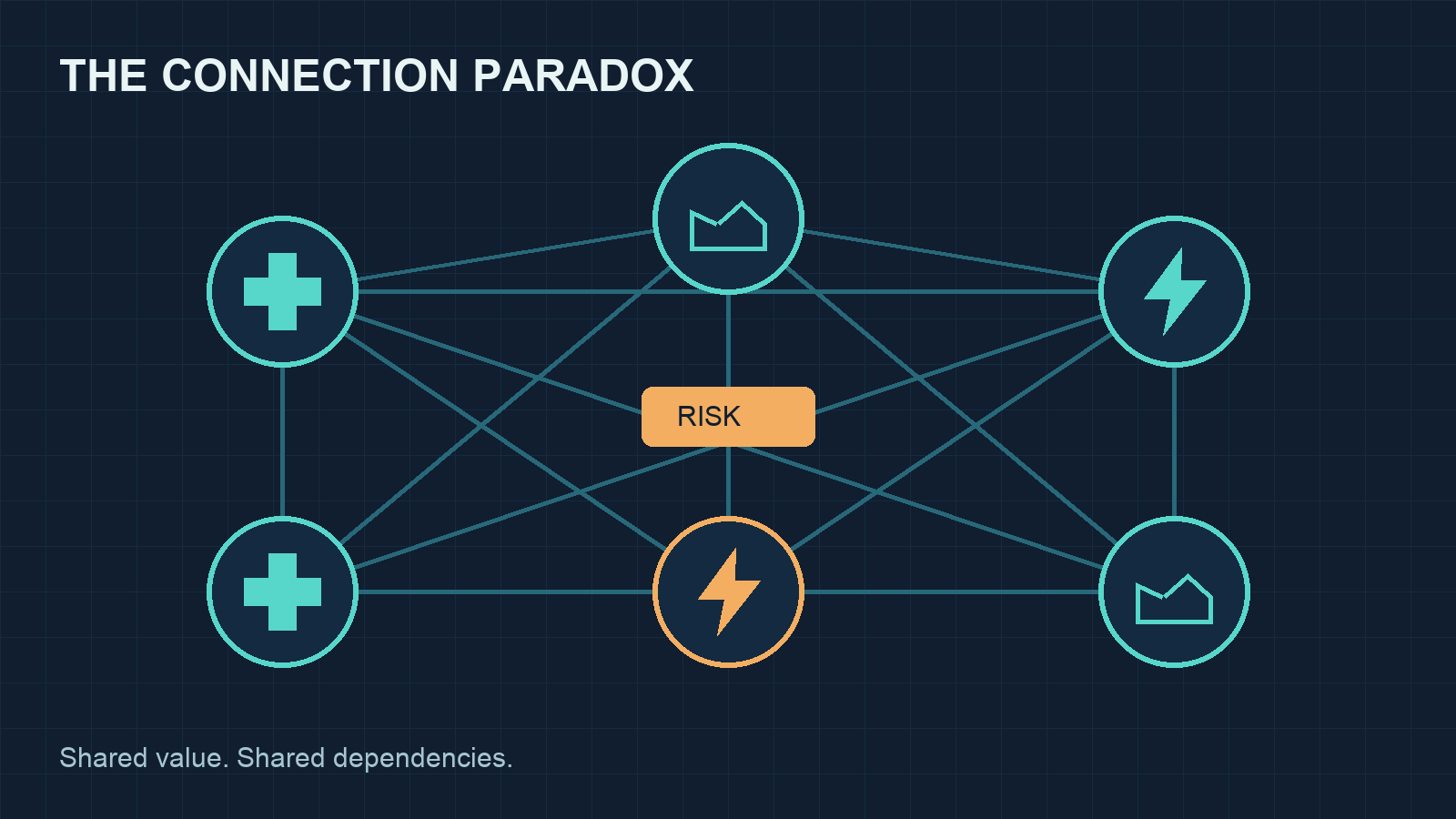
A connected machine can support better maintenance. A shared clinical record can help coordinate care. A networked energy system can make distribution more responsive. These are not imaginary benefits invented by a marketing department.
But each connection also changes what the organisation depends on. Information must arrive, identities must be trustworthy and systems must behave within acceptable limits. The connection that creates value can also provide a route through which disruption spreads.
This is the connection paradox. We cannot understand the benefit properly while treating the resulting exposure as an unrelated technical detail.
Value and exposure arrive together
Connecting a service is not automatically a mistake. Nor does every connection create the same level of risk. Architecture, access controls, maintenance and the way a service is operated make substantial differences.
Nevertheless, connectivity expands the set of interactions an organisation must understand. A remote maintenance facility can reduce repair times while introducing a dependency on a supplier and its access arrangements. A shared record can improve collaboration while increasing the importance of availability and permissions. Efficiency and exposure can originate in the same design decision.
The mistake is to approve that decision on the basis of its benefits and postpone the discussion of its dependencies until implementation is almost complete. At that point, security is frequently asked to solve a strategic trade-off without being allowed to change the strategy.
The accounting problem
The economic benefit of a new connection is often easier to present than the cost of a possible future disruption. Reduced administrative work, faster production or easier access can be translated into familiar objectives. The consequences of an incident depend on circumstances and may never materialise in the reporting period.
That creates an incentive problem. The team introducing the service can receive credit for measurable improvements, while the consequences of a poorly understood dependency may be carried elsewhere in the organisation, or later in time.
An unexamined risk is not the same as an accepted risk. Genuine acceptance requires a decision-maker to understand what might fail, what the consequences would be and what measures are available. Merely leaving the subject out of a presentation does not constitute a risk appetite.
After an incident, this distinction becomes painfully clear. Before an incident, it is inconvenient enough to be ignored.
Political control is not the same as resilience
States differ in their ability to restrict connectivity and impose requirements. Authoritarian systems may face fewer political obstacles when introducing broad restrictions. Democracies must reconcile security with rights, competition and limits on public power.
It would be a mistake, however, to turn that observation into a claim that authoritarian control automatically produces stronger cybersecurity. Filtering information, concentrating authority and maintaining the continuity of an essential service are different activities. Restrictions can reduce particular forms of exposure while creating other dependencies and weaknesses.
The relevant question is not simply how much control a state can impose. It is whether the measures actually protect the functions people rely on, and at what cost to rights and economic activity.
For democratic societies, resilience has to be built through accountable decisions, proportionate obligations and cooperation across public and private organisations. The difficulty of that task is real. It does not make indiscriminate isolation a sound technical strategy.
Neither disconnect everything nor promise perfection
Disconnecting every system would sacrifice useful services and still fail to remove every source of operational risk. Equally, claiming that everything can be connected safely without qualification confuses an aspiration with a guarantee.
A more useful approach begins with purpose. Why is this connection needed? What information or authority should pass through it? What should never be reachable from the other side? Can the benefit be achieved with less access or a narrower dependency?
These questions make segmentation, limited privileges and controlled supplier access matters of service design rather than decorative additions. The objective is not merely to prevent entry. It is also to limit the consequences when a component, account or relationship is compromised.
Make the failure scenario operational
Resilience becomes meaningful when it describes an actual capability. If an essential service loses a network connection, what continues? For how long? Who has the authority to switch to an alternative procedure? What information must remain available, and how will its integrity be checked?
Recovery plans need the same specificity. A backup is useful only if restoration works within the time the service can tolerate. An alternative procedure is useful only if people can carry it out under realistic conditions. A supplier assurance document is useful only to the extent that it tells the organisation something dependable about the service it receives.
None of these measures makes compromise inevitable or excuses weak prevention. Prevention, detection, containment and recovery belong together. Preparing for failure is a way of reducing its consequences, not a declaration that defence is pointless.
Governance begins before the incident
The connection paradox cannot be delegated entirely to a security team. The organisation choosing the benefit must also own the resulting dependency. That means assigning responsibility, funding the necessary controls and deciding which levels of disruption are unacceptable.
The board does not need to approve every firewall rule. It does need to understand whether an essential function depends on arrangements that have never been tested, whether a proposed saving transfers risk elsewhere and whether the organisation can explain how it would continue operating under stress.
Cyber resilience is therefore not an extra layer placed around modern society. It concerns the structure through which that society delivers care, production, energy and information.
Perfect security is a promise nobody can make honestly. Continuing to deliver an essential service when part of the system fails is a capability an organisation can build, test and demonstrate. That is the more useful conversation.
Raffaele Di Marzio
All my “insane” books on cybersecurity and governance are here 👇 https://www.amazon.it/stores/author/B0FB47T6Q4/allbooks