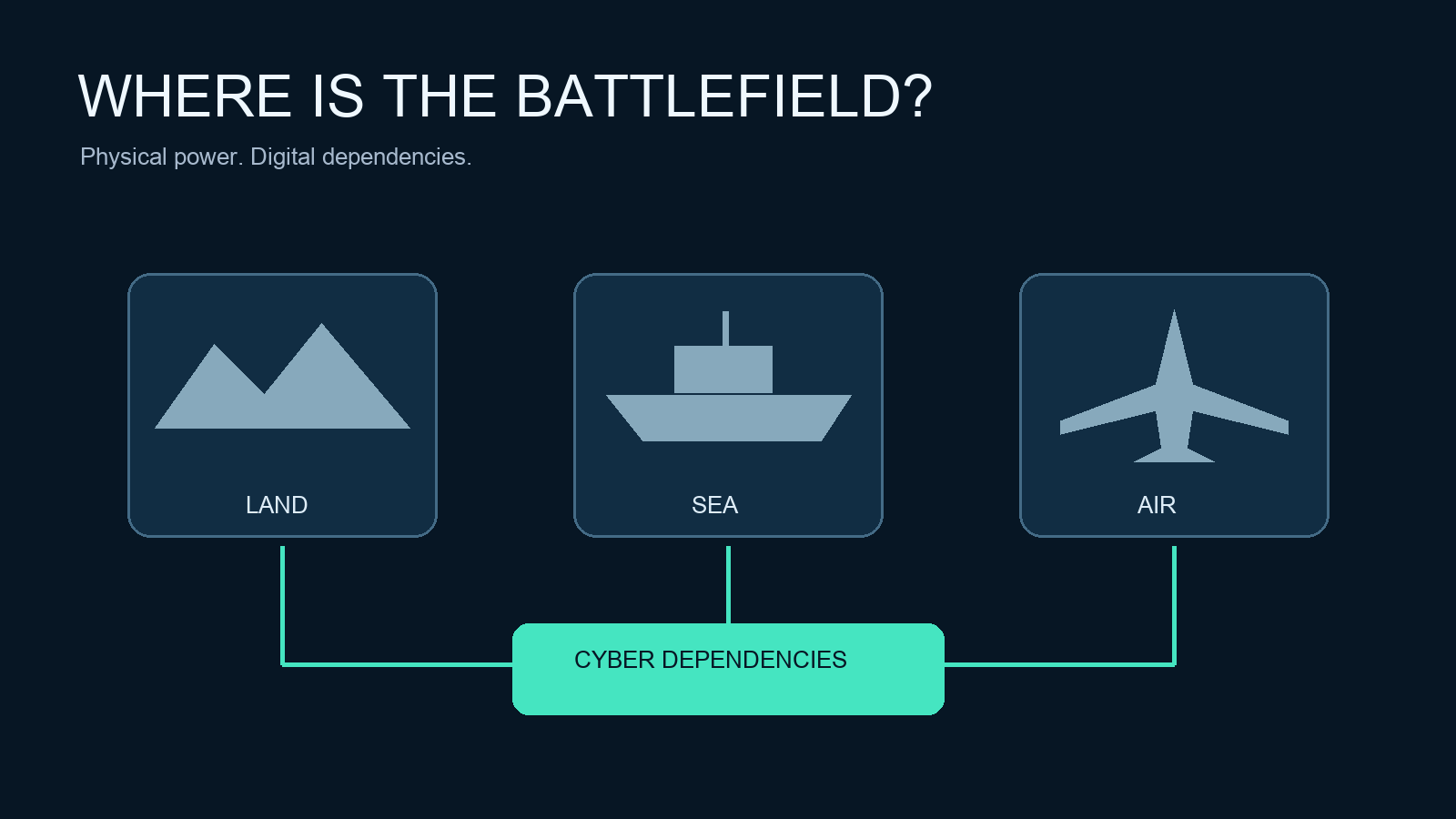
A tank can retain its armour while receiving the wrong information. A ship can remain afloat while losing confidence in its position. A military organisation can possess formidable equipment yet struggle to coordinate it. The battlefield is not confined to the places where something visibly explodes.
That is the strategic significance of cyber conflict. It is not simply another weapon placed alongside an existing arsenal. It changes the dependencies through which an arsenal becomes usable. To understand that change, it helps to follow the widening of the battlefield from land to sea and air, and then into the digital systems running through them.
Land: power through territory
Land warfare makes the relationship between force and control unusually tangible. Territory provides access to people, resources, production and routes. Walls, castles and defensive lines are physical expressions of the same ambition: make entry expensive, delay the attacker and preserve the ability to govern what lies behind the defences.
Technology has repeatedly altered the means of fighting on land. It has not removed the importance of occupation, movement, supply or the protection of populations. Nor has digital technology made territorial sovereignty obsolete. Physical locations still matter, including the locations of the infrastructure on which digital services depend.
The difficulty begins when a territorial map is treated as a complete map of vulnerability. A border tells us where a jurisdiction lies. It does not, by itself, tell us which external services, networks or suppliers can affect what happens inside it.
Sea: power through circulation
Maritime power adds a different strategic concern: controlling movement rather than merely holding ground. Trade routes and supply lines connect economies to resources they do not possess locally. A country can retain its territory while suffering severe disruption to the flows that sustain it.
Alfred Thayer Mahan made sea power central to his account of national strength. The enduring insight is not that every conflict can be reduced to naval superiority. It is that the ability to move goods and project force depends on routes, access and the protection of connections.
Submarine cables make that insight relevant to digital infrastructure as well. Communications that appear weightless on a screen rely on physical systems laid across the seabed. Damage to a cable is not automatically a cyberattack, and an outage is not automatically sabotage. Nevertheless, the connection between maritime infrastructure and digital continuity prevents us from treating these domains as separate boxes.
Air and space: reach, observation and dependence
Aircraft expanded the ability to observe and strike beyond a land front. The development of military aviation during the twentieth century changed reconnaissance, industrial vulnerability and the relationship between distance and protection.
Space systems extended some of those capabilities through communications, observation and positioning. Space is also treated as a distinct operational domain; grouping it with air here is a way of following the expansion of reach, not a claim that the two are identical.
These advantages bring dependencies. Navigation, targeting and coordination rely on information that must be available and trustworthy. Drones make the relationship particularly visible: their effectiveness can depend on control software, communications links and positioning services. Disruption need not take the form of physically destroying the aircraft. Electronic warfare and cyber operations offer different ways of interfering with the systems around it, although they should not be confused with one another.
Cyber: the domain running through the others
Digital networks developed over decades, not at a single moment when someone decided to open a new battlefield. Their growth connected organisations, equipment and services that had previously operated with fewer shared dependencies.
The strategic consequence is straightforward. A system that can exchange information can also become part of an attack path. Compromised identities, manipulated data or unavailable services may affect decisions and operations far beyond the machine first targeted.
Cyberspace is not immaterial. It relies on servers, cables, power, people and organisations. Its distinctive feature is the relationship between those physical foundations and logical connections that cross borders. An operation can involve infrastructure in several jurisdictions without fitting neatly into the territorial picture familiar from a conventional invasion.
International law is not absent from cyberspace. The difficulties include applying existing principles to particular operations, establishing responsibility and determining how states should respond. Uncertainty about attribution or thresholds is not the same as a legal vacuum.
Asymmetry without magic
Some offensive cyber capabilities have a lower entry cost than a navy or an air force. That creates opportunities for smaller states and non-state actors to impose costs on much larger organisations.
It does not follow that sophisticated operations are cheap, that attackers can do anything, or that a small team can reliably dominate a national infrastructure. Intelligence, access, persistence and operational discipline still matter. The asymmetry is nevertheless significant: defenders must keep a complex service working, while an attacker may need only one useful route to a particular objective.
This is also why purchasing more security products cannot, on its own, settle the problem. A collection of tools is not equivalent to an organisation capable of detecting disruption, making decisions and recovering under pressure.
Defending dependencies, not just assets
Land forces need logistics and communications. Ships need navigation and coordination. Aircraft rely on software and information. Digital compromise can degrade those functions without first eliminating the equipment that uses them.
Cyber capability does not guarantee victory, and conventional force does not become irrelevant. The point is that physical strength can depend on digital conditions that are poorly represented in inventories of vehicles, ships or aircraft.
A useful strategic assessment therefore asks not only what an organisation owns, but what must continue to work for those assets to remain useful. Which identities authorise action? Which data can be trusted? Which suppliers are indispensable? Which functions can continue when a network is unavailable?
Resilience begins when those questions have operational answers: tested recovery, alternative procedures, clear authority and an understanding of the services that matter most.
The modern fortress still needs walls. But if its drawbridge depends on a compromised control system, the height of those walls is no longer the whole story.
Raffaele Di Marzio
All my “insane” books on cybersecurity and governance are here 👇 https://www.amazon.it/stores/author/B0FB47T6Q4/allbooks