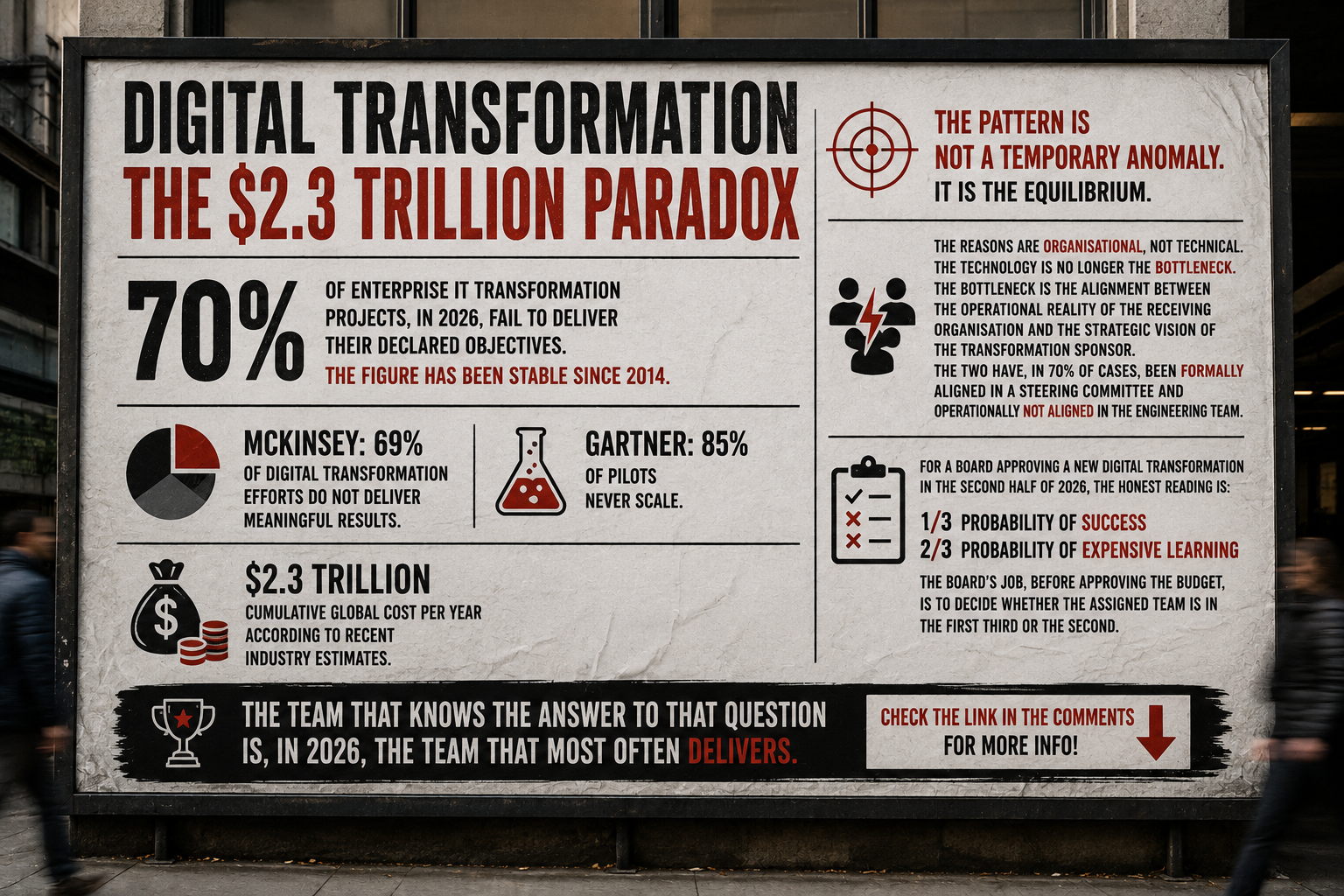
The headline statistic about enterprise IT transformation, in 2026, is a number that has not meaningfully changed in twelve years. Seventy percent of declared transformation projects fail to deliver their stated objectives. The figure is reported by McKinsey, by Gartner, by Deloitte, by the Standish Group’s CHAOS Report, by the Project Management Institute, and by every major industry analyst that has measured the outcome of enterprise digital programmes since 2014. The instruments have changed, the technologies have changed, the consulting frameworks have multiplied. The percentage has not.
This article reads the statistic for what it documents, structurally, and proposes how a board should respond to it before approving its next transformation in 2026.
The numbers
McKinsey’s most recent survey on digital transformation, cited across the industry through 2026, records that sixty-nine percent of digital transformation efforts do not deliver meaningful business outcomes. Gartner’s pilot-to-scale analysis records that eighty-five percent of enterprise AI and digital pilots never scale beyond the pilot stage. Deloitte’s 2024 cost analysis records an average overrun of forty-seven percent in failed digital projects, with five hundred thousand dollars in direct losses per failed project and fifteen million dollars in direct losses per failed ERP implementation. The Standish Group’s CHAOS Report records that thirty-one percent of digital transformations complete on schedule. The cumulative cost of failed transformations, according to an industry estimate replicated across multiple analysts, is two point three trillion dollars per year. Ninety-seven million dollars of every billion spent on technology, the same estimate adds, ends up tied to a project that does not deliver.
These are not the numbers of a temporary anomaly. They are the numbers of an equilibrium.
The diagnosis is not technical
The reasons for the seventy percent, by the joint diagnosis of every major consulting firm that has studied the question, are organisational rather than technical. The technology, in 2026, is no longer the bottleneck. Cloud infrastructure works. Container orchestration works. API gateways work. Identity providers work. Data pipelines work. The toolchain is, by any historical comparison, mature.
What does not work, with the same consistency, is the alignment between the operational reality of the receiving organisation and the strategic vision of the transformation sponsor. The two have, in seventy percent of cases, been formally aligned in a steering committee and operationally not aligned in the engineering team. The steering committee has agreed that the transformation will deliver a thirty percent productivity uplift by Q4. The engineering team has agreed that the platform will be production-ready by Q4. The two statements are not, technically, in contradiction. They are also not, operationally, the same statement.
The platform will be production-ready by Q4 means that the platform will be deployed, configured, and available for use. The thirty percent productivity uplift by Q4 means that the receiving organisation will have adopted the platform, retrained its workforce on the new workflows, restructured its processes around the new capabilities, decommissioned its legacy systems, and absorbed the cultural change required for the new way of working. The first statement is a delivery commitment by the engineering function. The second statement is a transformation commitment by the entire organisation. The seventy percent failure rate is, in practice, the percentage of programmes in which the first commitment was met and the second was not.
What the disalignment looks like in the field
The steering committee meets monthly. It reviews a dashboard. The dashboard has fifteen key performance indicators. Fourteen are green. One is yellow because of a vendor delay that was already escalated. The steering committee minutes record progress against milestones. The minutes are circulated to the board. The board is reassured. The vendor is paid. The next milestone is approved.
The engineering team meets weekly. It tracks a backlog. The backlog has four hundred and seventy items. Sixty of those items are technical debt accumulated from the previous transformation. Forty are dependencies on systems owned by other parts of the organisation. Thirty are integration points with legacy systems whose owners have left the company. The team works against the backlog. The team delivers the platform. The team has no formal mechanism to communicate, to the steering committee, that the platform delivery is not the transformation outcome the board has been promised.
The two surfaces, the dashboard and the backlog, document two different realities of the same programme. The steering committee dashboard says the programme is on track. The engineering backlog says the programme is delivering a platform that the organisation, in the form expected by the dashboard, will not adopt. The seventy percent failure rate is the empirical measurement of the gap between the two surfaces.
This is not a hidden failure mode. It has been documented, in some form, in every digital transformation post-mortem published by McKinsey, Bain, BCG, and Deloitte over the past decade. The corrective actions recommended in those post-mortems have, on average, not changed the seventy percent. The corrective actions are technically sound. The conditions that produce the seventy percent are structural to the way enterprise transformation programmes are governed.
The three questions the board should ask
A board approving a new IT transformation in the second half of 2026 has the benefit of twelve years of data on what tends to happen next. The honest assessment, before the budget is signed, requires three specific questions.
The first question is whether the steering committee dashboard and the engineering team backlog measure the same definition of success. If the dashboard measures milestones and the backlog measures deliverables, the two are documenting different programmes. The question for the sponsor is which of the two the board is buying. The answer determines whether the board is approving a delivery or a transformation. They are not the same thing.
The second question is whether the receiving organisation has agreed, at the operational level, to the changes that the transformation will require. Operational agreement is not the same as steering committee endorsement. The receiving organisation includes the line managers, the team leads, the senior individual contributors, the people who actually use the systems the transformation is replacing. The question for the sponsor is whether these people, by name, have committed to operating under the new model. The answer is rarely yes when the programme is approved. The seventy percent failure rate is, in part, the percentage of programmes in which this question is asked too late, or not at all.
The third question is whether the assigned team has, on its own record, delivered a transformation of comparable scope before, with comparable constraints, and absorbed the consequences. The answer is binary. Either the team has, on its own record, navigated the kind of organisational complexity the programme will encounter, or it has not. The teams that succeed in transformation programmes are, in the available evidence, the teams that have done it before. The teams that fail are, more often than not, the teams for which the programme is their first attempt at this scale.
What characterises the first third
The thirty percent of transformation programmes that succeed, in the studied population, share three observable characteristics.
First, they are governed by a sponsor who has authority over both the delivery and the adoption sides of the programme. The sponsor is not a CIO who controls the engineering function but cannot mandate workflow changes in the business units. The sponsor is a chief executive, a chief operating officer, or a business unit leader who can require operational change in the receiving organisation as a condition of the transformation.
Second, they assume from the outset that the transformation will modify the operating model of the organisation, not merely replace one technology stack with another. The programmes that succeed treat the technology as the necessary condition and the operational change as the sufficient condition. The programmes that fail treat the technology as the sufficient condition and the operational change as a downstream consequence.
Third, the teams that succeed have, before they start, made a formal forecast of which workflows will change, which roles will change, which performance metrics will change, and how the changes will be measured. The forecast is wrong, often by a wide margin, but it exists. The teams that fail have, before they start, a transformation strategy document and no forecast of operational change. The two artefacts are not interchangeable.
The seventy percent failure rate of enterprise IT transformation, in 2026, is not a temporary problem awaiting a better methodology. It is the structural equilibrium of how enterprise transformation programmes are conceived, governed, and delivered. The methodology question has been studied, exhaustively, by every major consulting firm for twelve years. The methodology answer has not moved the percentage.
The board that approves a new transformation in 2026 has, available to it, the same data the board had in 2014, the same data the board had in 2020, the same data the board has in 2026. The honest reading of the data is that the programme has approximately a one-in-three probability of being cited, in three years, as a case of successful adoption. The remaining two-in-three probability is expensive learning. The board’s job, before signing, is to look at the team it has assigned and decide whether the team is in the first third or the second.
The team that knows the answer to that question is, in 2026, the team that most often delivers. The team that does not know the answer is, statistically, the team that contributes the next data point to the seventy percent.
All my books on cybersecurity and governance are here 👉 https://www.amazon.it/stores/author/B0FB47T6Q4/allbooks
My “unfiltered” podcast SPYK :
🎧 Apple Podcasts 👉 https://podcasts.apple.com/it/podcast/spyk-uk-edition/id1896617808?i=1000767770385
🎧 Spotify 👉 https://open.spotify.com/show/033fU0Ds43aJrquCYYltWV?si=4eaafac135e848df
Also on #iHeartRadio, #AmazonMusic / #Audible, #Castbox, #Deezer, #PodcastAddict, #Podchaser.
Sources: McKinsey on digital transformation; Gartner on pilot-to-scale; Standish Group CHAOS Report; Deloitte cost analysis cited via industry analysts; Mi3 on 70 percent failure rate; Integrate.io 50 data transformation statistics 2026.