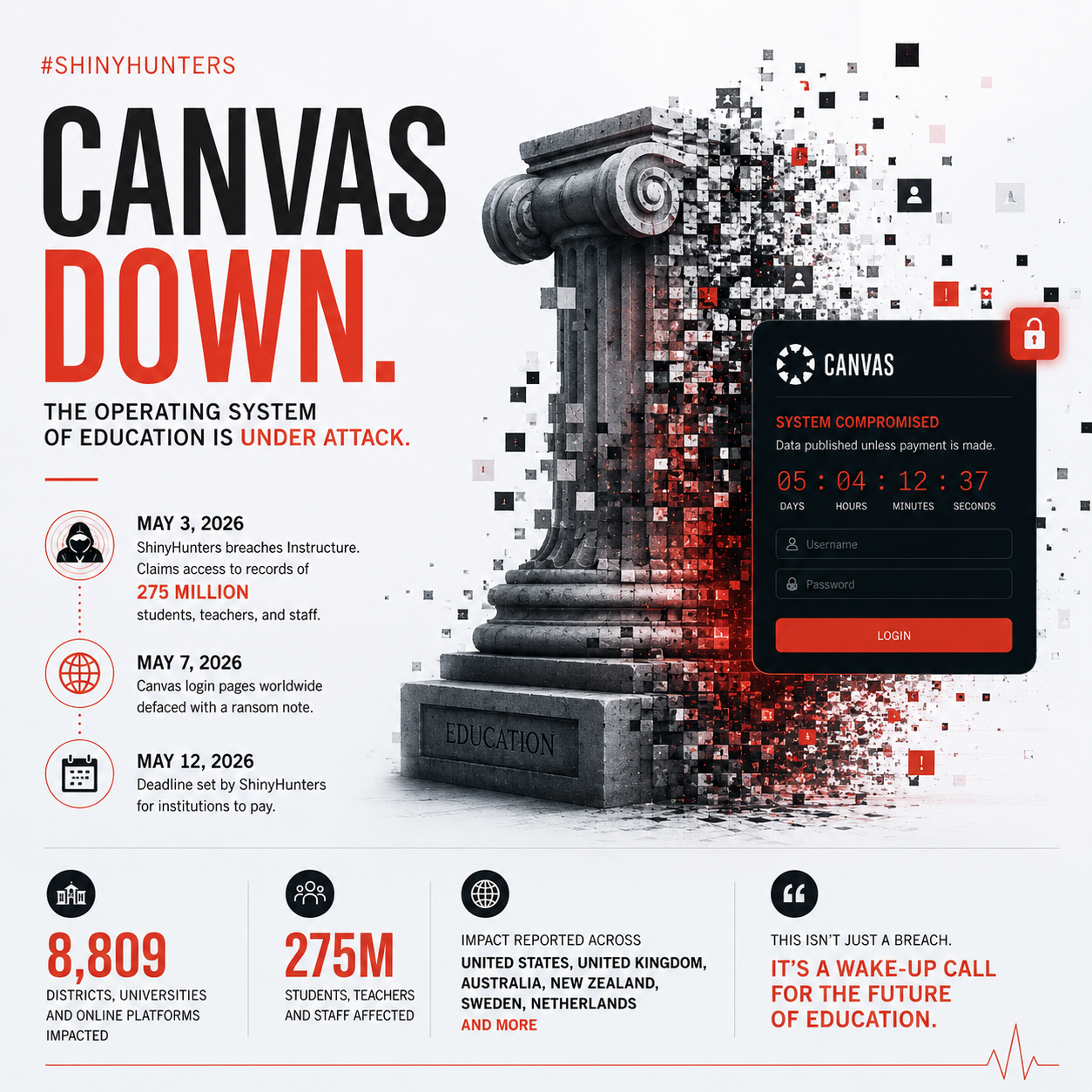
ShinyHunters, Instructure, and the Canvas Breach of May 2026 : On May 3, 2026, a cybercriminal group called ShinyHunters announced they had breached Instructure, the company that runs Canvas, the learning management system used by nearly nine thousand schools, universities, and online education platforms across the world. They claimed access to the records of 275 million students, teachers, and staff. Four days later, on May 7, Canvas login pages at multiple institutions were defaced with the group’s signature, replacing the welcome screen with a ransom note demanding payment by May 12, 2026.
This is not, primarily, a story about ShinyHunters. The group is well documented, and their pattern of operation, claim publicly, post a sample, demand payment, follow through with leaks if unpaid, is established. This is a story about what kind of system is being held hostage, and why we are surprised that it is.
What Happened, Chronologically
ShinyHunters first made the claim on May 3, 2026, on dark-web channels they routinely use for extortion announcements. They named Instructure as the victim, named Canvas as the affected platform, and named the population: 275 million records covering students, teachers, and administrative staff. They also shared a list, eventually obtained by the security press, of 8,809 individual institutions whose Canvas instances they claimed to have compromised, with per-institution record counts ranging from tens of thousands to several million.
By May 7, the second wave hit. Canvas login pages at multiple universities, including Harvard and the University of Pennsylvania, were defaced with the ShinyHunters signature. For Harvard, the disruption was reported by The Harvard Crimson the same day. For Penn, it was the second time in recent memory that the institution had appeared in a ShinyHunters disclosure, a fact reported by The Daily Pennsylvanian.
The geography of the disruption is broad. Educational institutions in the United States, the United Kingdom, Australia, New Zealand, Sweden, and the Netherlands reported either outages or notifications related to the breach. In the United States, San Diego campuses confirmed impact (NBC 7 San Diego), and multiple Missouri colleges reported being on the affected list (KSDK).
The deadline communicated by ShinyHunters for institutional ransom payment is May 12, 2026.
Sources: TechCrunch, Hackers deface school login pages after claiming another Instructure hack, https://techcrunch.com/2026/05/07/hackers-deface-school-login-pages-after-claiming-another-instructure-hack/ ; DataBreaches.Net, Developing: ShinyHunters Hacks Instructure Again; Canvas Down, https://databreaches.net/2026/05/07/developing-shinyhunters-hacks-instructure-again-canvas-down/ ; Malwarebytes Labs, Millions of students’ personal data stolen in major education cyberattack, https://www.malwarebytes.com/blog/news/2026/05/millions-of-students-personal-data-stolen-in-major-education-cyberattack ; The Harvard Crimson, Harvard Canvas Site Goes Down After University Listed in Instructure Breach, https://www.thecrimson.com/article/2026/5/8/canvas-breach-down/ ; The Daily Pennsylvanian, Cybercrime group crashes Penn’s Canvas system, demands ransom to prevent data release, https://www.thedp.com/article/2026/05/penn-canvas-shinythunters-data-breach-hack-second .
What Canvas Actually Is
To understand the scale of the exposure, it helps to remember what Canvas is in the operational reality of a modern educational institution.
Canvas is, for nearly nine thousand schools and universities, the place where assignments are submitted and graded, where attendance is logged, where reading materials are distributed, where discussion forums and group projects live, where instructor feedback is recorded, where grades are computed and stored, where parents (in K-12 deployments) are contacted, and where transcripts are generated. Adjacent to those academic functions, Canvas often integrates with student information systems, identity providers, library catalogs, video conferencing platforms, plagiarism detection services, third-party assessment vendors, and accessibility tools.
Canvas is not, in other words, a website. It is the operational substrate of academic life for millions of students, hundreds of thousands of educators, and tens of thousands of institutions. When Canvas is unavailable, an institution does not lose a website. It loses the connective tissue between its students, its instructors, and its records.
This is why a breach of Instructure is a breach of an enormous amount of personally identifying information, but also why the operational disruption matters as much as the data exposure. Most coverage in May 2026 focused on the 275 million figure. The more interesting figure, in the long run, is the number of students who could not submit an assignment, the number of instructors who could not access their gradebook, and the number of parents who could not be contacted, on the days the platform was being defaced and recovered.
The Monoculture Problem in EdTech
The deeper structural issue is monoculture. Education, like several other sectors in the last fifteen years, has consolidated onto a small number of dominant platforms. Canvas is one of two or three learning management systems that hold meaningful global market share. The others are Blackboard and Moodle, with Google Classroom occupying a related but distinct space.
Monoculture is efficient. Institutions get a maintained product, faculty are trained once, integrations are richer, costs scale predictably. Monoculture is also brittle. When a single platform is compromised, the blast radius is the size of the platform’s market share. The Canvas breach affects nine thousand institutions because the same supplier serves all nine thousand. A breach of an institution’s locally hosted system would have a blast radius of one institution.
This is the same dynamic that has played out in financial sector cloud concentration, in the Microsoft Exchange hosted-environment incidents of recent years, and in the SolarWinds supply-chain attack of 2020. The lesson is not “consolidate less.” Consolidation is rational. The lesson is “design for the day the consolidated supplier is the breach.”
What FERPA, GDPR, and Sector Rules Actually Require
The data exposed in the Canvas breach falls under different regulatory regimes depending on geography.
In the United States, the Family Educational Rights and Privacy Act (FERPA, 20 U.S.C. § 1232g) governs the privacy of student educational records. FERPA does not, by itself, mandate breach notification with the specificity that, for example, HIPAA does for healthcare. State-level breach notification laws do apply, and they vary considerably. The U.S. Department of Education has issued guidance over the years on how to interpret FERPA in the context of cyber incidents, but the framework was not designed for an era of supplier-driven breaches at this scale.
In the European Union, the General Data Protection Regulation (Regulation EU 2016/679) Article 33 imposes a 72-hour notification window from awareness of a breach to the relevant supervisory authority. For the Canvas case, that means each affected institution in the EU is on a clock that started running as soon as it became aware its data was in the breached set. The clock is per institution, not per Instructure. The institution is the data controller, Instructure is the processor, and the breach-notification obligation falls primarily on the controller.
The United Kingdom’s UK GDPR mirrors the EU framework. Australia’s Notifiable Data Breaches scheme under the Privacy Act 1988 imposes similar obligations. Each affected jurisdiction has, in this incident, its own clock and its own forms.
The result, in operational terms, is that thousands of compliance teams across multiple legal systems are simultaneously assessing whether the population whose data was on Canvas in their institution falls within their notification scope. This is what cyber incident response actually looks like at the level of educational sector regulation in 2026: a fragmented multi-jurisdictional effort, each institution running its own playbook, on data that is held by a single supplier.
The May 12 Deadline and What Comes After
ShinyHunters has set a payment deadline of May 12, 2026. The standard outcome of these deadlines, when payment is not made, is partial or full publication of the data on the group’s leak site. The data, once published, becomes available for criminal use indefinitely.
There are three operational tracks happening in parallel as the deadline approaches.
The first is forensic. Instructure’s incident response team, almost certainly with the support of an external incident response firm and possibly with law enforcement coordination, is establishing the actual perimeter of the breach, distinguishing what ShinyHunters claims from what was demonstrably exfiltrated.
The second is institutional. Each of the 8,809 institutions on the list is conducting its own assessment of exposure, communicating with its own legal counsel, preparing its own notifications, and managing its own stakeholders. For some, this means handling press inquiries. For others, it means rebuilding faculty access during exam season. For others still, it means explaining to parents why their child’s grade history may be on a dark-web forum next week.
The third is regulatory. National and supranational data-protection authorities are receiving filings, opening investigations, and signaling to the market what their interpretation of the incident will be. The CNIL in France, the ICO in the United Kingdom, the OAIC in Australia, the Datatilsynet in Sweden, and equivalent authorities elsewhere will issue, in the coming months, decisions and guidance shaped by what they observe now.
What the Incident Implies for the Next Decade
Education was not the first sector to digitize, and it will not be the last to learn the lesson that consolidation creates concentration risk. What is distinctive about the Canvas breach is the visibility of the dependency. When a hospital is hit by ransomware, the public sees clinics close. When a port is hit, the public sees freight delays. When Canvas is hit, the public sees a generation of students unable to submit homework, an admissions system that cannot generate transcripts, and a parent communication system that goes silent during finals week.
This visibility creates a political opening that healthcare and finance have not fully exploited. Education is the sector where the public most clearly identifies its own children with the systems being attacked. That identification is a policy resource. Used well, it could push EdTech toward the kind of resilience requirements that DORA imposes on financial services, that NIS2 imposes on critical infrastructure, and that the EU AI Act is starting to impose on high-risk AI systems.
What is missing, again, is not technology. The technology to harden Canvas-like platforms exists. What is missing is regulatory pressure aligned with the actual blast radius, and a procurement culture in education that treats the choice of LMS the way a financial institution now treats the choice of cloud provider: not as a convenience decision, but as a critical-infrastructure decision.
The Canvas breach of May 2026 is a demonstration. The question is whether the demonstration translates into a different posture by the time the next one happens. The pattern so far suggests it usually does not. Education has time to prove the pattern wrong.
All my books on cybersecurity and governance are here 👉 https://www.amazon.it/stores/author/B0FB47T6Q4/allbooks