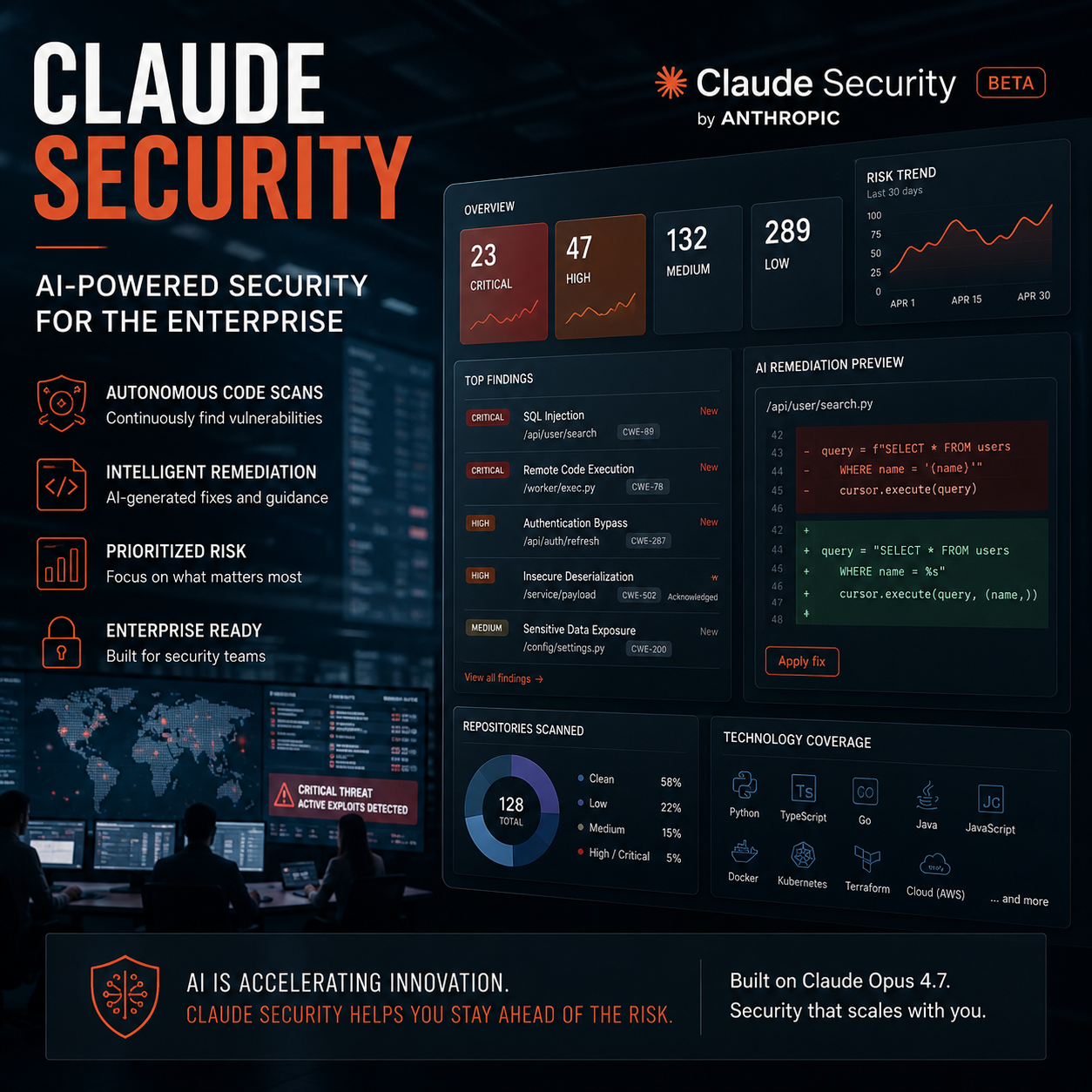
On April 30, 2026, Anthropic launched a product called Claude Security. It is in public beta, available to Claude Enterprise customers, and it is designed, in the company’s own framing, to counter the surge of AI-powered exploits and defend agentic workflows.
The launch is reasonable in isolation. The market needs that kind of tooling. Read against the previous quarter, however, the launch tells a more interesting story than the press release. Q1 2026 was a brutal three months for Claude itself. The pattern of incidents that occurred between January and April raises a structural question that no security product alone can answer: when an AI is also an agent, who is the defender, and what exactly are they defending?
What follows is a sober walk through the documented incidents, an analysis of the common pattern, and a strategic reading of what the launch implicitly admits.
The Product (April 30, 2026)
Claude Security is positioned as a defense layer for AI agents. The public-beta announcement framed it as a response to “AI-powered exploits” and to the broader category of attacks that target large language models in production environments. Detection of prompt-injection patterns, monitoring of agentic workflows, and integration with enterprise security operations centers are among the stated capabilities. The product is restricted to Claude Enterprise customers in the beta phase.
The framing matters. Anthropic is naming a category, “AI-powered exploits,” that did not exist as a marketed defense category five years ago, and is offering a commercial answer to it. This is a sign of market maturation. It is also, read alongside the events of the previous quarter, a sign of how fast the threat surface has expanded.
Source: SecurityWeek, Anthropic Unveils Claude Security to Counter AI-Powered Exploit Surge.
A Brutal Quarter for Claude Itself
January 2026 — Claude Cowork and indirect prompt injection
In January, security researchers at PromptArmor demonstrated that Claude Cowork, the desktop agent designed to autonomously organize and manage local files, could be manipulated through indirect prompt injection. By embedding instructions in documents the agent was asked to process, an attacker could induce the agent to exfiltrate sensitive files outside the user’s intended workflow, without explicit user consent.
The technique is called indirect because the malicious instruction does not come from the user. It comes from a document, an email, or a webpage that the agent reads as part of its task. The agent is doing exactly what it was designed to do, namely interpret natural language input and act on it. The attack exploits the fact that the agent does not, and cannot, reliably distinguish between input that is data and input that is instruction.
Sources: creati.ai, Anthropic’s Claude Cowork AI Found to Have Critical Security Vulnerability, https://creati.ai/ai-news/2026-01-19/anthropic-claude-cowork-security-vulnerability/ ; ucstrategies.com, Anthropic shipped Claude Cowork with a known security flaw — then gave it to millions anyway.
March 2026 — “Claudy Day” and the three chained flaws
In March, researchers disclosed three vulnerabilities affecting claude.ai and the broader claude.com platform. Chained together, they formed a complete attack pipeline.
The first flaw involved invisible HTML tags embedded in a URL parameter that pre-filled the Claude.ai chat box. The user would see a normal-looking prompt and press Enter, while the hidden instructions would be executed silently as part of the same conversation.
The second flaw allowed those hidden instructions to embed an attacker-controlled API key. Once present, Claude could be instructed to search the user’s conversation history for sensitive content, write that content to a file, and upload the file to the attacker’s Anthropic account through the legitimate Files API.
The third flaw was an open redirect on claude.com/redirect, accepting any third-party target URL without validation, which made the delivery of malicious links indistinguishable from legitimate Anthropic links.
The combination, branded “Claudy Day,” moved the conversation about AI security from theoretical to demonstrably exploitable in a way that did not require any technical sophistication on the user’s part.
Sources: DarkReading, ‘Claudy Day’ Trio of Flaws Exposes Claude Users to Data Theft, https://www.darkreading.com/vulnerabilities-threats/claudy-day-trio-flaws-claude-users-data-theft ; Oasis Security, Claude.ai Prompt Injection Vulnerability, https://www.oasis.security/blog/claude-ai-prompt-injection-data-exfiltration-vulnerability .
March 2026 — The Chrome extension as a zero-click vector
In the same month, a flaw in the Anthropic Claude Chrome extension was disclosed. The flaw allowed any website the user visited to silently inject prompts into the extension as if the user had typed them. The attack was zero-click. Visiting a maliciously crafted page was sufficient.
Sources: The Hacker News, Claude Extension Flaw Enabled Zero-Click XSS Prompt Injection via Any Website, https://thehackernews.com/2026/03/claude-extension-flaw-enabled-zero.html .
March 31, 2026 — The Claude Code source leak
On March 31, 2026, Anthropic accidentally shipped a debugging JavaScript sourcemap with the npm package @anthropic-ai/claude-code version 2.1.88. The sourcemap contained the unobfuscated client-side TypeScript of Claude Code: approximately 513,000 lines of code distributed across 1,906 files.
Anthropic responded quickly, attributing the incident to a missing exclusion rule in the build configuration, and confirming that no customer data or credentials had been exposed. The root-cause attribution was, in the company’s words, “human error, not a security breach.”
The operational consequence was nonetheless significant. Pre-existing vulnerabilities in Claude Code, including CVE-2025-59536 and CVE-2026-21852, became substantially easier to weaponize once the agent harness was readable in plain TypeScript. The leak coincided with an unrelated malicious npm supply-chain attack on the Axios package on the same day, creating a compound exposure window for anyone updating their toolchain that morning.
Sources: Zscaler ThreatLabz, Anthropic Claude Code Leak, https://www.zscaler.com/blogs/security-research/anthropic-claude-code-leak ; SecurityWeek, Critical Vulnerability in Claude Code Emerges Days After Source Leak, https://www.securityweek.com/critical-vulnerability-in-claude-code-emerges-days-after-source-leak/ ; Coder.com, What the Claude Code Leak Tells Us About Supply Chain Security, https://coder.com/blog/what-the-claude-code-leak-tells-us-about-supply-chain-security .
CVE-2026-21852 — API token exfiltration without user interaction
CVE-2026-21852 is a vulnerability in Claude Code project files that allowed an adversary to harvest a developer’s API key with no user interaction required. The scope is broader than the typical malicious-repository scenario because it affected the way Claude Code handled project configuration, hooks, MCP server definitions, and environment variables.
Source: Check Point Research, Caught in the Hook: RCE and API Token Exfiltration Through Claude Code Project Files, https://research.checkpoint.com/2026/rce-and-api-token-exfiltration-through-claude-code-project-files-cve-2025-59536/ .
The Pattern
Reading the five incidents together, three structural threads emerge.
First, every incident exploited the agentic dimension. None of these flaws would have been impactful, or in some cases even possible, on a chatbot that only generated text. Claude Cowork is dangerous because it acts on files. The Chrome extension is dangerous because it operates inside the browser context. Claude Code is dangerous because it executes commands and reads project secrets. The shift from chatbot to agent is not a UX evolution. It is an attack-surface event.
Second, prompt injection is the connective tissue. Whether the injection comes through a URL parameter (Claudy Day), through a document the agent processes (Claude Cowork), through a webpage (Chrome extension), or through a project configuration file (CVE-2026-21852), the underlying mechanism is the same. The agent reads natural-language input, interprets it, and acts. The agent cannot reliably distinguish between content the user authored, content the user trusts, and content delivered by a third party with malicious intent.
Third, the supply-chain dimension is real and underappreciated. The Claude Code sourcemap leak was, technically, a build configuration error. Operationally, it was a supply-chain incident. The package was distributed through npm, the standard JavaScript package registry, where it intersected with a separate malicious npm attack the same day. Any defender treating Anthropic’s distribution channel as inherently more secure than a generic npm package should reconsider that assumption.
Prompt Injection Is the SQL Injection of This Era
The historical analogy is not perfect, but it is structurally instructive. SQL injection emerged in the late 1990s because applications combined user input and database commands in the same string, without separating data from instruction. Two decades of remediation produced parameterized queries, prepared statements, and ORM frameworks that, when used correctly, eliminate the class.
Prompt injection has the same shape. Applications combine user input, system instructions, and third-party content in the same context window, without separating data from instruction. The agent processes all of it as natural language. There is no equivalent of a parameterized query for prompts, because the model’s strength, generalization across linguistic patterns, is also its weakness.
The defenses currently available are perimeter-style: input sanitization, output filtering, allow-list of tools, structured output schemas, monitoring of suspicious agent behavior. Each is useful. None is structurally complete in the way parameterized queries are structurally complete for SQL.
This is not a critique of the defenders. It is a statement of where the field is. We are in the late-1990s phase of LLM security. Selling a security product into this phase is reasonable. Treating the product as a closure to the problem is not.
What This Tells Us About AI Procurement
For enterprises considering or deploying agentic AI, three procurement-grade conclusions follow from the Q1 2026 record.
Defensive primitives must include the agent’s runtime, not only the model. Buying a foundation model is buying a component. Deploying an agent is deploying a runtime that reads, decides, and acts. The threat model is closer to the runtime than to the model.
Vendor incident transparency matters more than vendor incident absence. No agentic AI vendor is going to be incident-free in 2026. The relevant signal is how quickly and clearly incidents are disclosed, attributed, and patched. Anthropic’s response on the Claude Code leak (rapid public statement, root-cause attribution, denial of customer data exposure) is, on that metric, defensible.
Supply-chain provenance for AI tooling is now a board-level concern. The Claude Code distribution channel was npm, alongside the Axios incident. Enterprises that have spent the last five years hardening their software supply chain need to extend the same discipline to their AI tooling, not as an afterthought but as a primary procurement requirement.
What the Launch Implicitly Admits
The most strategically interesting thing about Claude Security is not what the product does. It is what the product implicitly admits.
By launching a defense layer specifically for AI agents, Anthropic is acknowledging, in a commercial form, that the agentic dimension of its own products is the attack surface. That admission is more useful than any single feature in the product. It tells the market what to budget for. It tells regulators what to scope. It tells researchers where to look.
The product itself will be evaluated on its merits. The signal sent by the product, however, is already useful. The agents are the attack surface. The defense is going to be commercial, layered, imperfect, and continuously updated. And the period in which an enterprise could deploy an AI agent and assume the security model was solved is over.
All my books on cybersecurity and governance are here 👉 https://www.amazon.it/stores/author/B0FB47T6Q4/allbooks