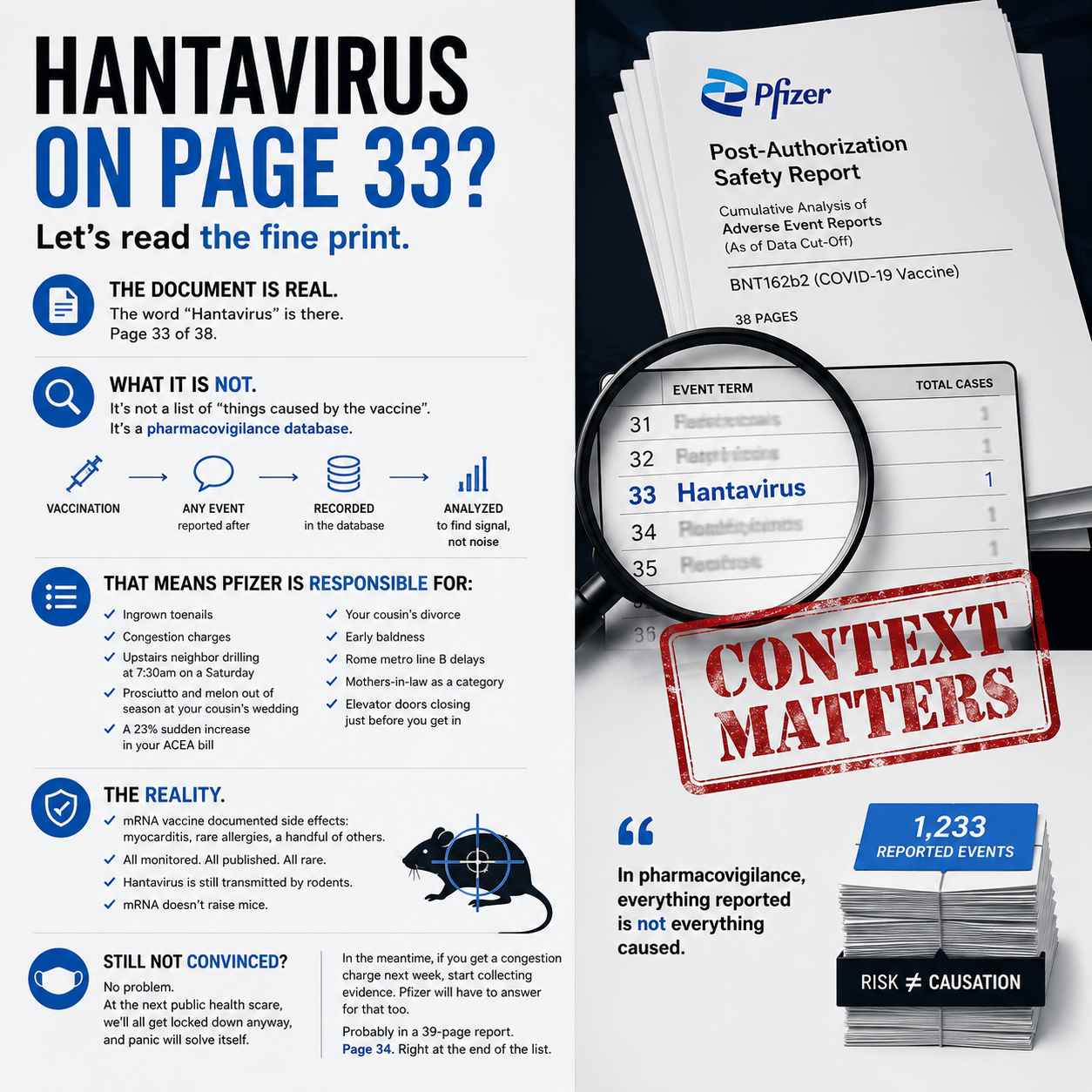
A Crash Course in Pharmacovigilance for Weekend Alarmists : Yes, I know. You were scrolling, and someone posted that “Hantavirus is listed on page 33 of Pfizer’s 38-page document, one of 1,233 side effects, so the COVID vaccine is about to turn into a virus, you have a ticking time bomb inside you.” You felt suddenly informed. You forwarded it to three group chats. Bravo, all of you.
Now let us breathe, have a coffee, and start over.
The Honest Premise, Because It Matters
There is, in fact, a Pfizer/FDA document where “hantavirus pulmonary infection” appears in an appendix. The document is real, public, and downloadable. What is not real is the meaning the post assigns to it.
Those documents are called pharmacovigilance databases. They catalogue any medical event reported after a vaccination, anywhere, by anyone. Not “events caused by the vaccine”. Events that happened afterward. Period. If you get vaccinated tomorrow and break your ankle the next day after slipping on the way back from the supermarket, that ankle goes in the database. Not because the vaccine broke your ankle, but because the database is designed to catch every reported signal so that, later, statisticians can separate the coincidences from the actual side effects.
This is statistics 101. It is not a conspiracy. It is the difference between correlation and causation, taught in the first two lessons of any methodology course, before they get to the Pearson coefficient.
The Complete List of Everything Pfizer Has Caused, According to the Same Logic
If appearing in a post-event database were proof of causation, here is the updated and definitive list of Pfizer’s responsibilities, compiled with the same epistemological rigor:
ingrown toenails. Marital infidelity. ZTL fines, the historic-center kind, naturally. Epididymitis. Post-orgasmic drowsiness. The systematic difficulty of remembering where you parked the SUV. The upstairs neighbor drilling at 7:30 on Saturday morning. Prosciutto e melone served out of season at your cousin’s wedding. The ACEA electricity bill that mysteriously rose 23 percent. That same cousin’s divorce. Premature baldness. The chronic delays on Rome’s Metro line B. Rain on someone’s wedding day, somewhere. Roma losing in away games. Mozzarella that tastes of plastic. Mothers-in-law, in general. Inflation. The fact that the elevator doors close the moment before you arrive.
All documented. All recorded. All, according to this school of thought, caused directly by Pfizer.
Causation Is Not Correlation, a Shocking Discovery for People Who Skipped Statistics in High School
If two events happen in temporal sequence, it does not mean the first caused the second. Otherwise the sun would rise because I drank coffee, and the morning traffic on the Roma-Tangenziale would be caused by the morning news.
The logic of post-marketing surveillance databases is precisely to separate the noise (coincidences) from the signal (real side effects). When an event appears with statistically anomalous frequency in the vaccinated population compared to the unvaccinated population, then causality is investigated. When it appears once per million doses, and in the general population it occurs once per million per year anyway, it is a coincidence. This is called base rate. Epidemiologists know it. The European Medicines Agency knows it. The FDA knows it. After five minutes on Wikipedia, you know it too.
The Actual Confirmed Side Effects of mRNA Vaccines
After billions of doses and four years of monitoring, the genuinely confirmed adverse effects of COVID mRNA vaccines are the following:
- Myocarditis and pericarditis. Rare. Disproportionately observed in young males, particularly after the second mRNA dose. Documented by the CDC, the European Medicines Agency, and the UK’s Medicines and Healthcare products Regulatory Agency.
- Severe allergic reactions, including anaphylaxis. Very rare. Managed routinely in vaccination centers with the same protocols used for any vaccine.
- Thrombosis with thrombocytopenia syndrome. Rare. Associated primarily with non-mRNA viral-vector vaccines (AstraZeneca, Johnson & Johnson), not with mRNA vaccines.
That is the list. It is short. It is well known. It is monitored. It is published in scientific literature with the kind of statistical methodology that distinguishes signal from noise.
Hantavirus is not on that list. It was never on that list. It will not be on that list, because hantaviruses are zoonoses transmitted primarily through aerosolized rodent urine and feces. The Hantaviridae family was identified in the 1970s. mRNA does not breed mice.
What This Episode Tells Us About Public Discourse
The Pfizer-document-page-33 post is now in its third or fourth viral cycle. Each cycle, a fresh wave of readers discovers the document, locates the word “hantavirus”, does not consult what a pharmacovigilance database is, and concludes that the vaccine causes hantavirus, that the establishment is hiding it, that we are all carrying a ticking time bomb in our bodies.
What the episode actually demonstrates is something more interesting than the alleged conspiracy. It demonstrates how a public that has spent two decades being told that “the data is out there, just look it up” can fail spectacularly when the data requires more than literacy to interpret. The data was out there. The reading of the data was not.
This is not unique to Pfizer. It applies to every database of post-event signals: airline incident reports read as proof of unsafe airlines, cancer cluster maps read as proof of environmental causation, climate model uncertainty intervals read as proof that climate science is unsettled, cybersecurity vulnerability databases read as proof that a vendor is hopelessly insecure, post-incident corporate review documents read as confessions. The pattern is the same. A database designed to surface signals for expert evaluation gets read by non-experts as a verdict.
The honest response is not to hide the data. It is to insist, repeatedly, on the rule that data without methodology is just text.
So yes, hantavirus appears in that document. No, it does not mean the vaccine causes it. Yes, somebody who was vaccinated was later registered as having hantavirus, because in a sample of millions of people, somebody will always have anything, after anything else. No, hantavirus continues to be transmitted through rodents, exactly as it was in 1993 when it was first isolated in the southwestern United States.
If this explanation is unsatisfying, no problem. At the next viral health alarm, they will lock us down again, and the panic will sort itself out. It is a recurring cycle of the species. In the meantime, if a ZTL fine arrives in your mailbox in the coming weeks, start gathering evidence. Pfizer will have to answer for that as well. Probably in a 39-page report, page 34, near the bottom of the appendix, between “elevator-door anxiety” and “mozzarella plasticization syndrome”.
All my “insane” books on cybersecurity and governance are here 👉 https://www.amazon.it/stores/author/B0FB47T6Q4/allbooks